Fact sheet
- Latin name
- Reticulum (Ret)
- Brightest star
- α Reticuli (α Ret)
- Relative brightness
- 3.32 mag
- Hipparcos catalogue
- HIP 19780
- Area
- 114 deg² (rank: 82 out of 88)
- Right ascension
- 3h 13m 27s to 4h 37m 06s
- Declination
- -67° 14' 53'' to -52° 44' 49''
- Neighbouring constellations
- Horologium, Hydrus, Dorado
Visibility
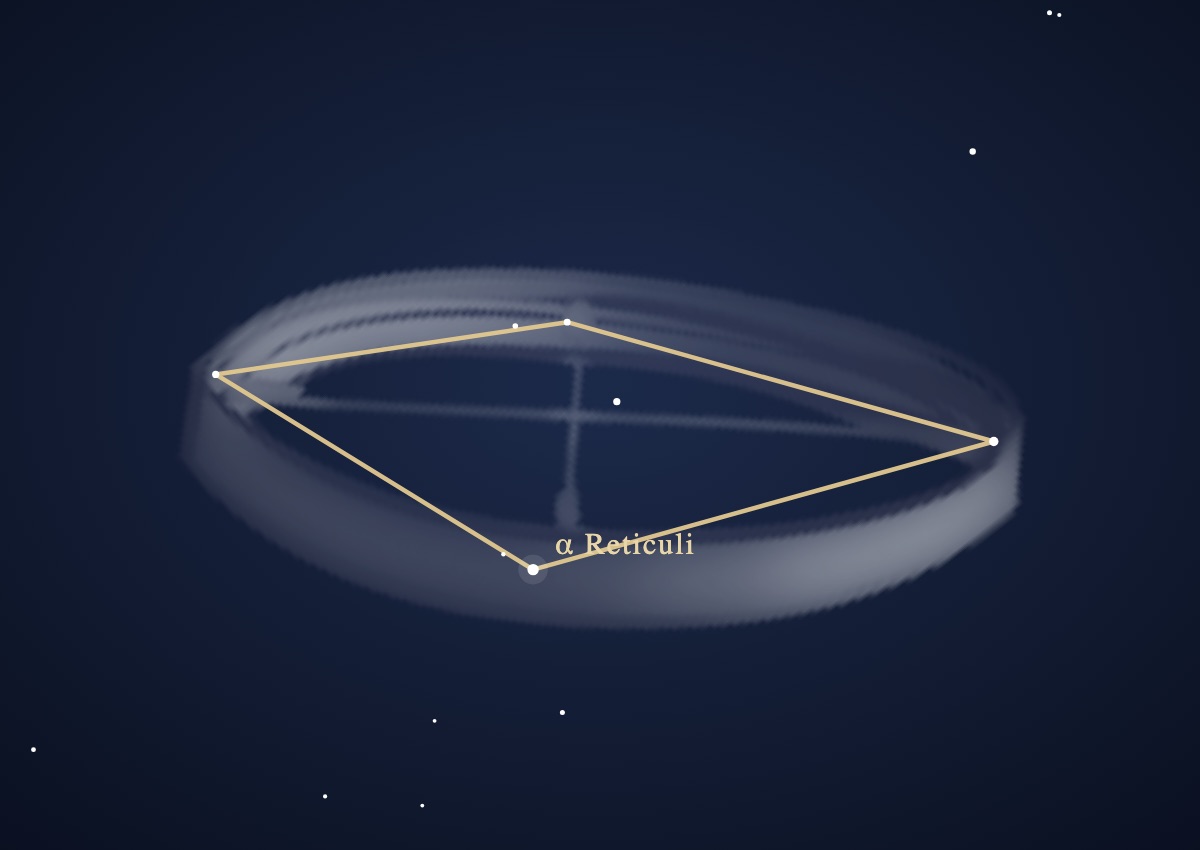
The constellation Reticulum
Reticulum is a constellation of the southern hemisphere. It is partly circumpolar around the South Pole. This means that some of its stars are so close to the celestial pole that they never set as seen from Sydney. Part of the constellation is therefore above the horizon all year round there.
It is easy to find, because it lies roughly halfway between the bright stars Canopus and Achernar, the main stars of the constellations Carina and Eridanus. It is also close to the Large Magellanic Cloud. This is a dwarf galaxy about 160,000 light years away with many billions of stars.
History
The French theologian Nicolas-Louis de Lacaille, who devoted his life to astronomy, geodesy and mathematics, introduced 14 new constellations of the southern hemisphere. In 1750, he set off on a four-year journey to the Cape of Good Hope in order to observe, among other things, the constellations of the southern sky. During this time, he catalogued almost 10,000 stars. Nicolas-Louis de Lacaille named most of his new constellations after technical instruments. In this way, the constellations Sculptor, Fornax, Caelum, Antlia, Pictor, Microscopium, Reticulum, Octans, Horologium, Pyxis, Mensa, Telescopium, Norma and Circinus came into being. He also divided the large ancient constellation Argo Navis into the three constellations Carina, Puppis and Vela. His star catalogue of the southern sky was published in 1763, one year after his death, under the title “Coelum Australe Stelliferum”. What his 14 new constellations have in common is that they consist of relatively faint stars.
The constellation was invented by the German astronomer Isaac Habrecht II, who showed it on a celestial globe in 1621. However, he did not publish the constellation himself until 1628, in his book “Planiglobium coeleste et terrestre”. In the meantime, the constellation had become known through the German astronomer Jacob Bartsch, who published it in his star charts in 1624 under the name “Rhombus” (diamond shape). In 1752, however, Nicolas-Louis de Lacaille renamed this constellation “Reticulum Rhomboidalis” (rhomboid net). By this rhomboid net he meant the engraved net in the eyepiece of a telescope, which was used in the past to measure the positions of stars.