Fact sheet
- Latin name
- Apus (Aps)
- Brightest star
- α Apodis (α Aps)
- Relative brightness
- 3.83 mag
- Hipparcos catalogue
- HIP 72370
- Area
- 206 deg² (rank: 67 out of 88)
- Right ascension
- 13h 49m 51s to 18h 27m 28s
- Declination
- -83° 07' 12'' to -67° 28' 48''
- Neighbouring constellations
- Triangulum Australe, Circinus, Musca, Chamaeleon, Octans, Pavo, Ara
Visibility
The constellation Apus
Apus (bird of paradise) is a constellation of the southern hemisphere. It is circumpolar around the South Pole. This means that its stars are so close to the celestial pole that they never set as seen from Sydney. The constellation is therefore above the horizon all year round there.
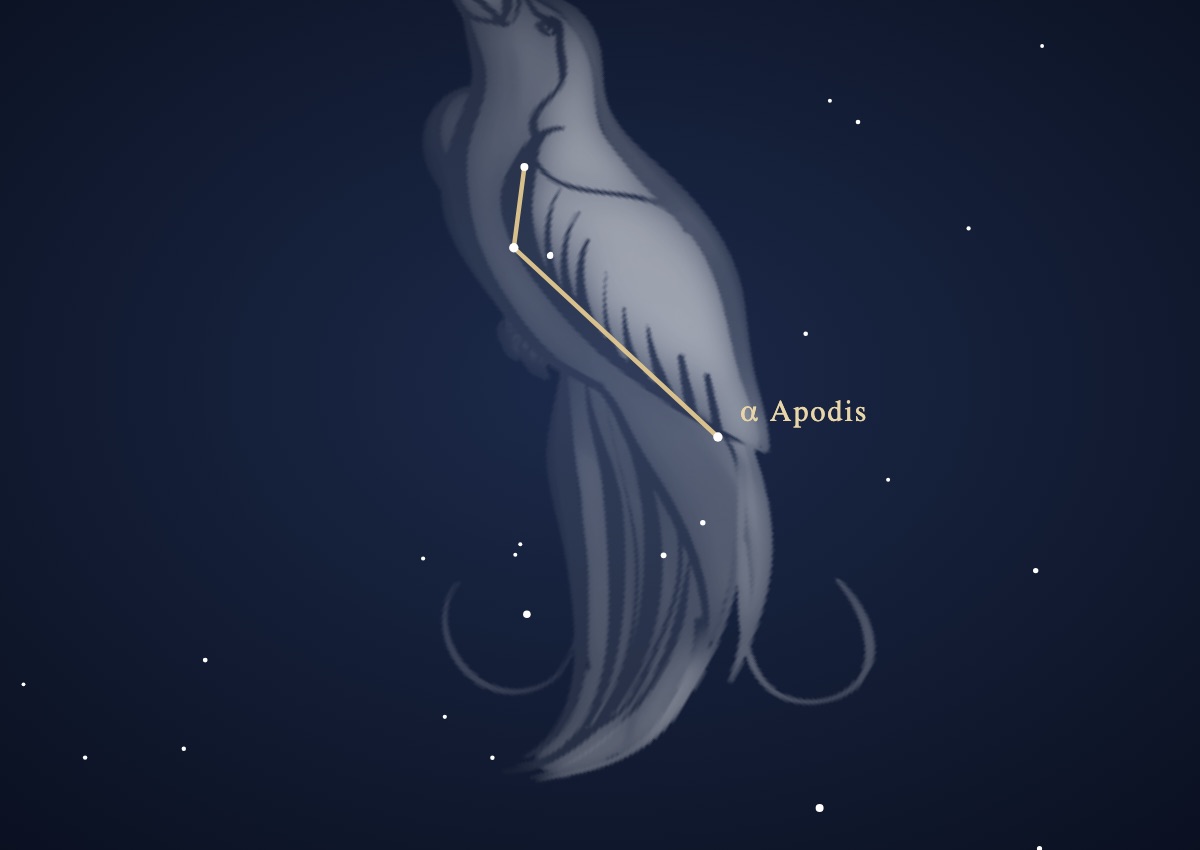
The constellation is faint and not easy to recognise in the sky. It lies between the south celestial pole and the constellation Triangulum Australe. The main stars of Apus are only about 13° away from the pole. Its brightest star, α Apodis, represents the tail feathers of the bird of paradise.
History
While the constellations of the northern hemisphere have been known since ancient times and are based on many different mythologies, many constellations of the southern hemisphere remained unnamed for a long time. It was not until the 16th century that people began to deal with them. Between 1595 and 1597, the Dutch seafarers Pieter Dirkszoon Keyser (chief navigator) and Frederick de Houtman (brother of the captain) mapped the southern sky on an expedition on behalf of Petrus Plancius. Influenced by their experiences on their voyage to the East Indies, they named a dozen constellations: Chamaeleon, Musca, Volans, Indus, Grus, Apus, Pavo, Phoenix, Dorado, Hydrus, Triangulum Australe and Tucana.
The seafarers may have encountered the bird of paradise in the tropical rainforests of New Guinea, in the Moluccas (an Indonesian group of islands) or in the tropical north of Australia. The male birds of paradise have brightly shining plumage and extremely long tail feathers, which they use to try to attract the attention of the females. For a long time, Europeans knew these feathers only as decorations on exclusive ladies' hats. The name Apus (genitive Apodis) comes from the Greek ápous (“footless”), because the skins of birds of paradise reached Europe without feet. Johann Bayer included the constellation in his star atlas in 1603 under the name “Apis Indica”. He took it from Petrus Plancius' globe of 1598. “Apis” (bee) there was probably a misprint for “Avis” (bird); the “Indian bird” was meant. Today, however, its original name, bird of paradise, has become established.