Fact sheet
- Latin name
- Leo Minor (LMi)
- Brightest star
- 46 Leonis Minoris (46 LMi)
- Relative brightness
- 3.83 mag
- Hipparcos catalogue
- HIP 53229
- Area
- 232 deg² (rank: 64 out of 88)
- Right ascension
- 9h 22m 35s to 11h 06m 51s
- Declination
- +22° 50' 15'' to +41° 25' 54''
- Neighbouring constellations
- Ursa Major, Lynx, Cancer, Leo
Visibility
The constellation Leo Minor
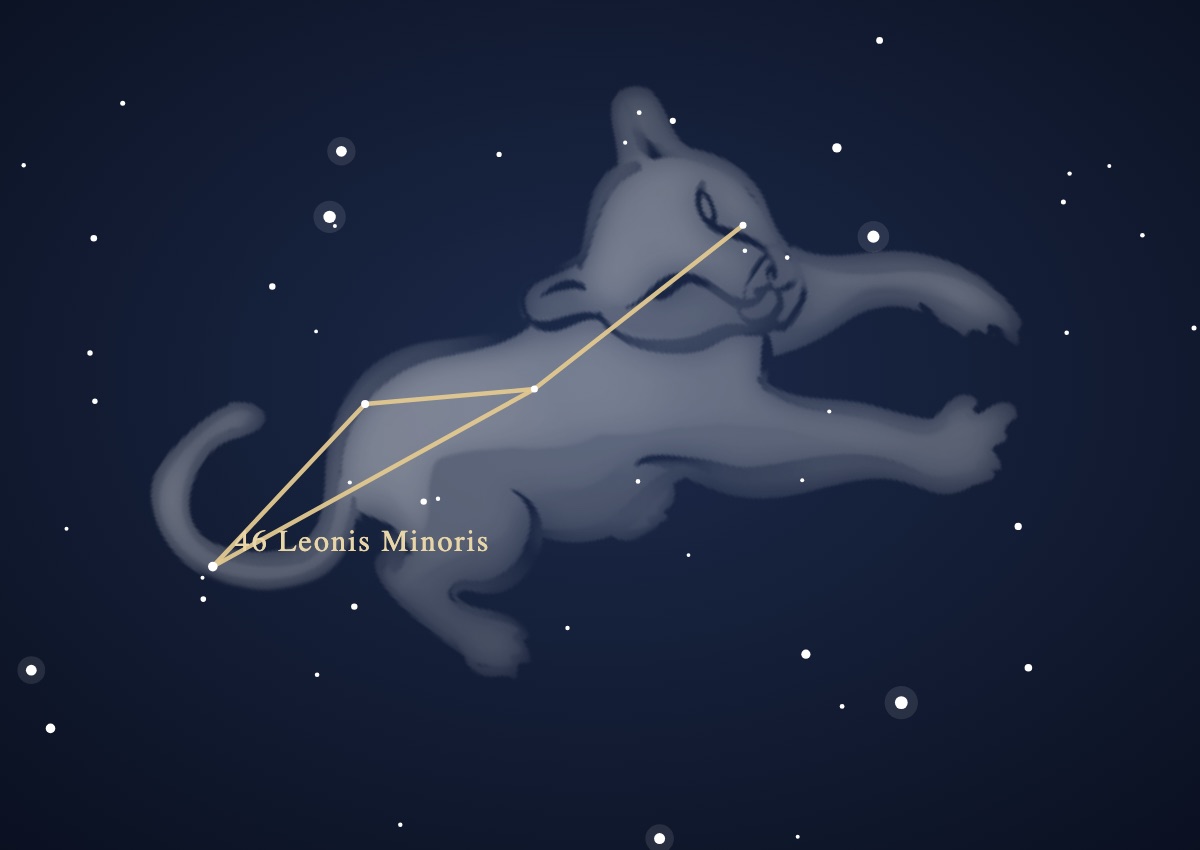
The constellation Leo Minor is a constellation of the northern hemisphere. It is partly circumpolar around the North Pole. This means that some of its stars are so close to the celestial pole that they never set as seen from Berlin. Part of the constellation is therefore above the horizon all year round there. Its brightest star is 46 Leonis Minoris, which also bears the name Praecipua (female leader). It represents the tail of the constellation Leo Minor.
The constellation lies directly above the constellation Leo and below the constellation Ursa Major, in a region with very faint stars. Sky watchers can best find their way by using the group of stars called the “Big Dipper” in the constellation Ursa Major or the brightest star of the constellation Leo, the star Regulus (little king).
History
The constellation was introduced in 1687 by Johannes Hevelius (1611–1687), an astronomer and the founder of lunar cartography. Apparently, this constellation was only meant to fill a gap in the sky, because there are no legends or stories at all about it. Its stars were also given names only in part. Johannes Hevelius had originally not given the stars any names. The name Praecipua probably originally referred to the star 37 Leonis Minoris and was later transferred to the brightest star. However, this name was only officially recognised by the International Astronomical Union (IAU) in 2017. The English astronomer Francis Baily (1774–1844) named the individual stars later, in his star catalogue published in 1845. In doing so, he gave the second brightest star of the constellation the name Beta Leonis Minoris. The brightest star, however, remained without a name. For this reason, this constellation has no star whose name begins with Alpha. To this day, the brightest star is called 46 Leonis Minoris. In Chinese astronomy, the brightest star of the constellation Leo Minor was known by the name 勢四 (Shì sì). This meant roughly “fourth star of the eunuch”.