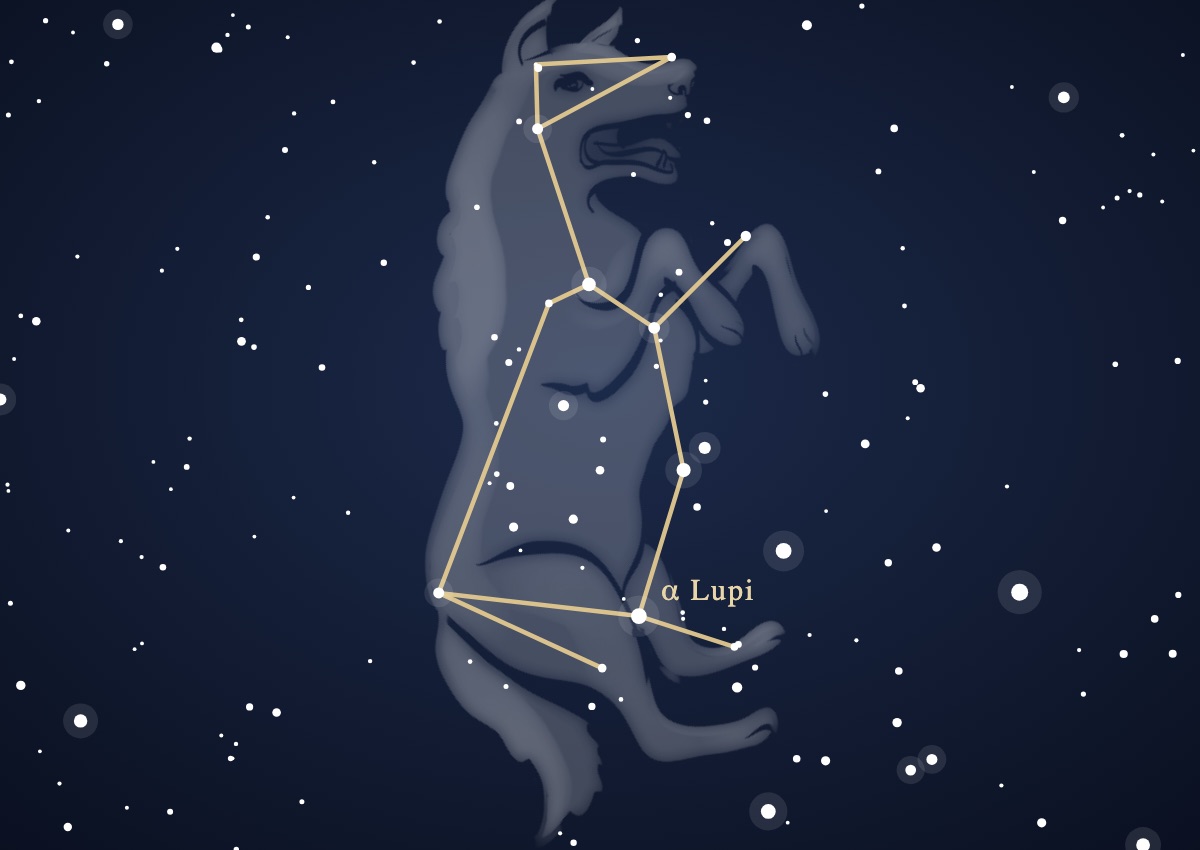
Fact sheet
- Latin name
- Lupus (Lup)
- Brightest star
- α Lupi (α Lup)
- Relative brightness
- 2.30 mag
- Hipparcos catalogue
- HIP 71860
- Area
- 334 deg² (rank: 46 out of 88)
- Right ascension
- 14h 17m 48s to 16h 08m 37s
- Declination
- -55° 34' 48'' to -29° 50' 16''
- Neighbouring constellations
- Libra, Hydra, Centaurus, Circinus, Norma, Scorpius
Visibility
The constellation Lupus
Lupus is a constellation of the southern hemisphere. Its brightest star is α Lupi. Opposite it lies its second brightest star, β Lupi. β Lupi is a hot, blue-white star of about nine solar masses. In the distant future, when the hydrogen in its core runs out, it will swell into a red supergiant. Then the wolf, which the centaur seems to be spearing with a lance, will have a red paw.
History and mythology
People have known the constellation Lupus since ancient times. Over thousands of years, many different peoples have connected a wide variety of stories and myths with the constellation. For example, the Arabs knew the constellation as a lioness or a leopard, the Syrians in the Euphrates valley as Zibu (animal of death), the Greeks as Therion (wild animal) and the Romans as Bestia (the beast). In ancient times the constellation was also often connected with the constellation Centaurus. The centaur is said to have placed a sacrificial animal, which he had speared on a lance, on the altar (constellation Ara). However, there is no ancient mythology about this at all, so this myth did not survive over time. At the latest when the French astronomer Nicolas-Louis de Lacaille (1713–1762) placed the constellation Norma between the constellation Centaurus and the constellation Ara, this myth disappeared for good.
The Babylonians (in what is now Iraq), on the other hand, knew the constellation as Ur-Idim (rabid dog). Magic spells have survived from writings dating from around 2000 BC that were meant to protect against the bites of an Ur-Idim. The bites of the Ur-Idim were believed to cause a deadly disease, which was very probably rabies.
In 1603, during the Renaissance, the German astronomer Johannes Bayer finally defined the constellation as a wolf in his celestial atlas Uranometria. He was the first to draw it in its present form. However, Bayer drew many figures from behind instead of from the front, so that older star descriptions such as “right hand” or “left foot” no longer matched his pictures.