Fact sheet
- Latin name
- Auriga (Aur)
- Brightest star
- Capella (α Aur)
- Relative brightness
- 0.08 mag
- Hipparcos catalogue
- HIP 24608
- Area
- 657 deg² (rank: 21 out of 88)
- Right ascension
- 4h 37m 54s to 7h 30m 56s
- Declination
- +27° 53' 29'' to +56° 09' 53''
- Neighbouring constellations
- Camelopardalis, Perseus, Taurus, Gemini, Lynx
Visibility
The constellation Auriga
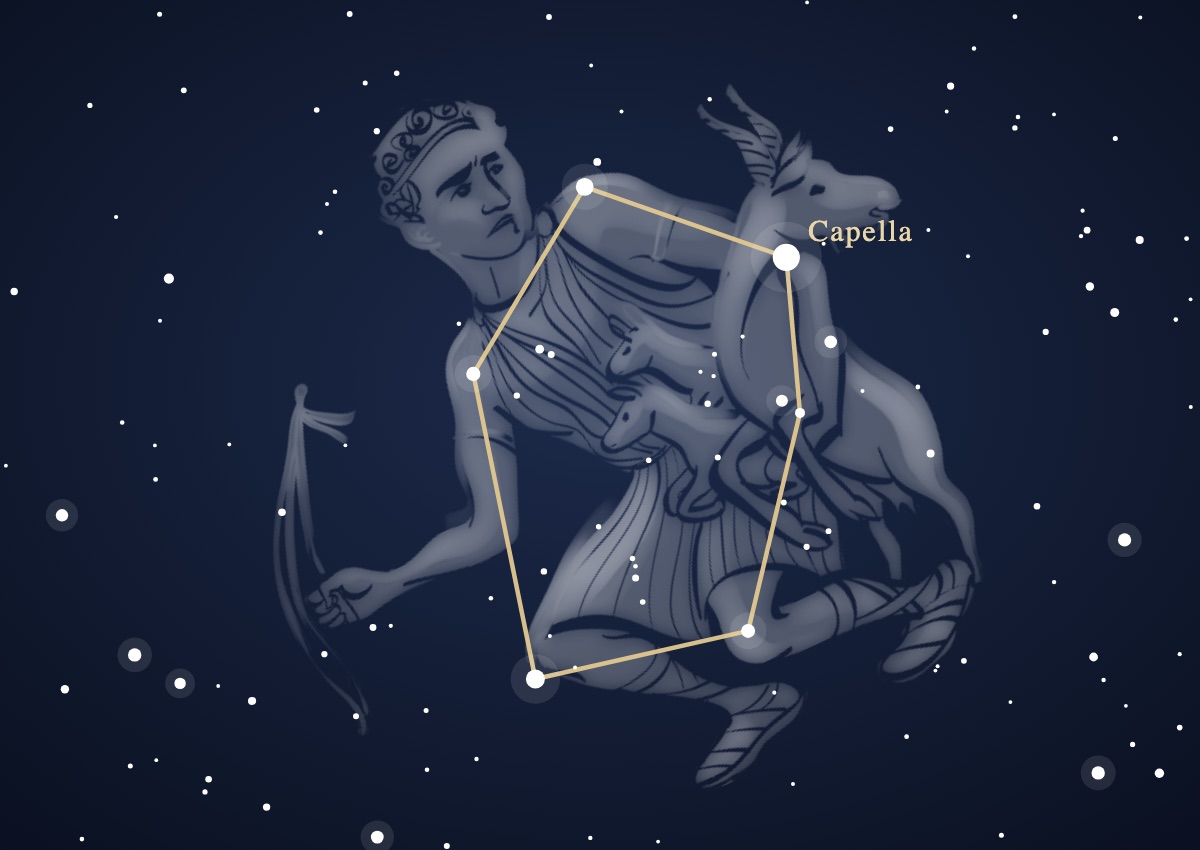
The constellation Auriga is a constellation of the northern hemisphere. It is partly circumpolar around the North Pole. This means that some of its stars are so close to the celestial pole that they never set as seen from Berlin. Its brightest star, α Aurigae or Capella (Latin for little goat), is the sixth brightest star in the sky. Auriga is roughly the shape of a kite. At its southernmost corner lies Elnath (β Tau), which belongs to Auriga on older star charts but, after the International Astronomical Union (IAU) adjusted the constellation boundaries, to Taurus. ε Aurigae is a puzzle: every 27 years it becomes noticeably fainter for almost two years, most recently from 2009 to 2011. It is then hidden by a huge disc of dust in which a companion star is concealed.
Mythology
There are several myths about Auriga. According to the best known, it represents Erichthonius, a king of Athens. He grew up with the goddess Athena, who taught him, among other things, how to tame horses. He was the first human to follow the example of the sun god Helios and harness four horses to his chariot. This earned him the admiration of Zeus and a place in the sky.
Another legend tells of King Oenomaus, a lover of horses who could not bear the thought of his eldest daughter Hippodamia getting married. He therefore challenged each of her suitors to a chariot race of life and death. His charioteer Myrtilus, a son of the god Hermes, however, accepted a bribe from the suitor Pelops and sabotaged the wheels of the king's chariot. The king had already killed all the other suitors in earlier races. In the last few metres, his wheels came off and he was dragged to death. Pelops wanted Hippodamia for himself and knew that Myrtilus was secretly in love with her. So he threw him into the sea, where he drowned. Hermes then placed his son in the sky as the charioteer.
According to a third legend, Cronus, the father of Zeus, was warned by the earth goddess Gaia that one of his descendants would overthrow him. He therefore swallowed all his children immediately after they were born. However, his wife Rhea managed to hide one of them from him: Zeus, who was raised on milk on Crete by the nymph Amalthea in the form of a goat. In the past, the goat on the charioteer's arm was regarded as a separate constellation. In gratitude for her milk, Zeus later placed the goat in the sky; her star is Capella. No legend tells why it is the charioteer, of all people, who carries her.