Fact sheet
- Latin name
- Sculptor (Scl)
- Brightest star
- α Sculptoris (α Scl)
- Relative brightness
- 4.30 mag
- Hipparcos catalogue
- HIP 4577
- Area
- 475 deg² (rank: 36 out of 88)
- Right ascension
- 23h 06m 43s to 1h 45m 50s
- Declination
- -39° 22' 21'' to -24° 48' 14''
- Neighbouring constellations
- Cetus, Aquarius, Piscis Austrinus, Grus, Phoenix, Fornax
Visibility
The constellation Sculptor
Sculptor is a constellation of the southern hemisphere. Its brightest star is α Sculptoris, which has an apparent magnitude of only 4.30 mag. The constellation lies south of the constellations Cetus and Aquarius and contains the galactic south pole, through which the axis of rotation of our Milky Way passes. Because here we look out of the disc of the Milky Way, distant galaxies can be seen particularly well, such as the bright spiral galaxy NGC 253. It belongs to the Sculptor Group, one of the nearest groups of galaxies beyond the Local Group.
History
The French theologian Nicolas-Louis de Lacaille, who devoted his life to astronomy, geodesy and mathematics, introduced 14 new constellations of the southern hemisphere. In 1750, he set off on a four-year journey to the Cape of Good Hope in order to observe, among other things, the constellations of the southern sky. During this time, he catalogued almost 10,000 stars. Nicolas-Louis de Lacaille named most of his new constellations after technical instruments. In this way, the constellations Sculptor, Fornax, Caelum, Antlia, Pictor, Microscopium, Reticulum, Octans, Horologium, Pyxis, Mensa, Telescopium, Norma and Circinus came into being. He also divided the large ancient constellation Argo Navis into the three constellations Carina, Puppis and Vela. His star catalogue of the southern sky was published in 1763, one year after his death, under the title “Coelum Australe Stelliferum”. What his 14 new constellations have in common is that they consist of relatively faint stars.
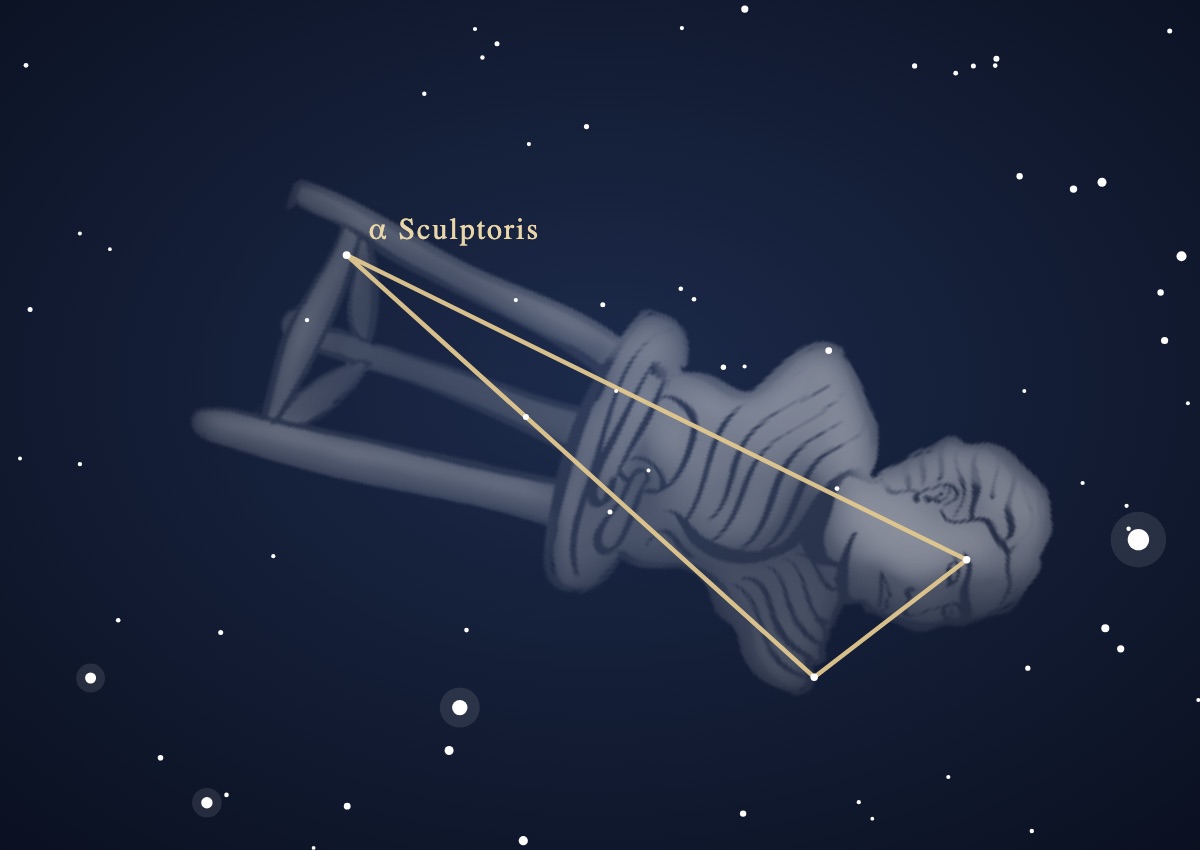
When Nicolas-Louis de Lacaille first mapped Sculptor in 1751 and 1752, he gave it the name "L'Atelier du Sculpteur" (the sculptor's workshop). Over the years, however, this original name was translated into Latin and shortened. Today the constellation is known by the Latin name Sculptor. The constellation is meant to represent a marble head in a sculptor's workshop, which lies on a workbench together with a mallet and a chisel.