Fact sheet
- Latin name
- Corvus (Crv)
- Brightest star
- Gienah Gurab (γ Crv)
- Relative brightness
- 2.59 mag
- Hipparcos catalogue
- HIP 59803
- Area
- 184 deg² (rank: 70 out of 88)
- Right ascension
- 11h 56m 22s to 12h 56m 40s
- Declination
- -25° 11' 46'' to -11° 40' 39''
- Neighbouring constellations
- Virgo, Crater, Hydra
Visibility
The constellation Corvus
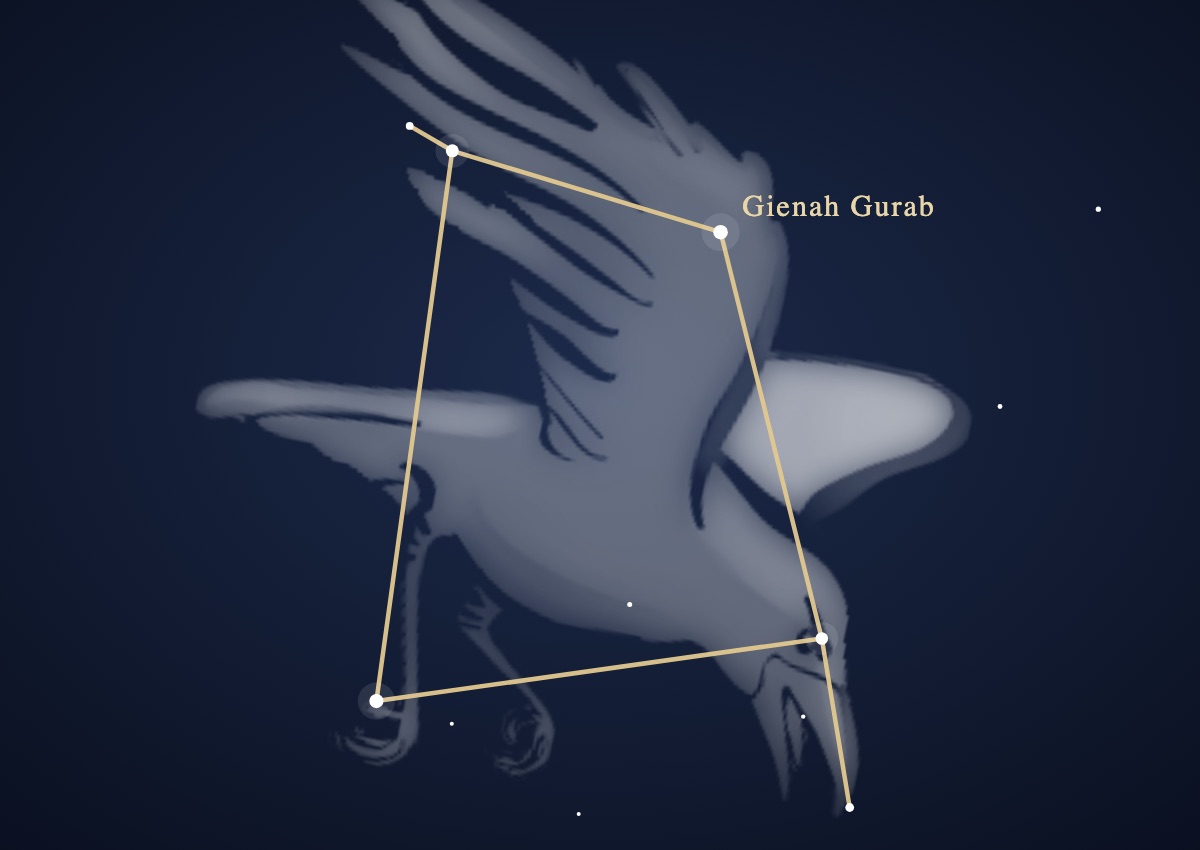
Corvus is a constellation of the southern hemisphere. Its brightest star, γ Corvi, bears the Arabic name Gienah Gurab (wing of the raven). Together with the stars β Corvi (Kraz), δ Corvi (Algorab) and ε Corvi (Minkar), it forms a figure in the shape of a sail.
Its two spiral galaxies NGC 4038 and NGC 4039 are especially interesting. The interaction between the two galaxies distorts them so strongly that, on long-exposure photographs, their long tidal tails look like the feelers (antennae) of an insect (hence the name Antennae Galaxies). Seen through a telescope, the two galaxies form the shape of a heart, which is especially popular every year on Valentine's Day.
Mythology
The constellation Corvus is linked to two legends. The first legend is about a raven, a water snake and a cup.
The raven was the bird of the god Apollo, a son of Zeus, the father of the gods. One day Apollo was preparing to make a sacrifice to his father. He sent out his raven to fetch fresh water from a spring. The raven took a gilded cup and flew away. On the way he spotted a fig tree, but its fruit was not yet quite ripe. Although Apollo had told him to hurry, he could not resist, and he waited there for several days until the figs were ripe. Full of figs and looking for an excuse, he grabbed a water snake and flew back to Apollo with it. He told Apollo that this water snake had blocked the way to the spring. However, Apollo saw through his lie. As a punishment, he took away the raven's ability to drink anything during the time when the figs ripen. He then placed the raven, the water snake and the cup in the sky. Since then, the raven has tried in vain to reach the filled cup. For the raven, being placed in the sky was therefore not an honour but a punishment in public view, like a pillory. Since that time it has been said that the hoarse croaking of ravens is caused by their great thirst.
In the second legend, the raven, which at that time still had snow-white feathers, brought Apollo the news that his pregnant beloved, Coronis, was being unfaithful to him. In his anger, Apollo killed Coronis and her lover. But at once he was filled with guilt. However, he only managed to save his unborn son. Full of pain, Apollo cursed the raven and coloured it black for ever.