Fact sheet
- Latin name
- Crux (Cru)
- Brightest star
- Acrux (α Cru)
- Relative brightness
- 0.77 mag
- Hipparcos catalogue
- HIP 60718
- Area
- 68 deg² (rank: 88 out of 88)
- Right ascension
- 11h 56m 14s to 12h 57m 45s
- Declination
- -64° 41' 46'' to -55° 40' 38''
- Neighbouring constellations
- Centaurus, Musca
Visibility
The constellation Crux
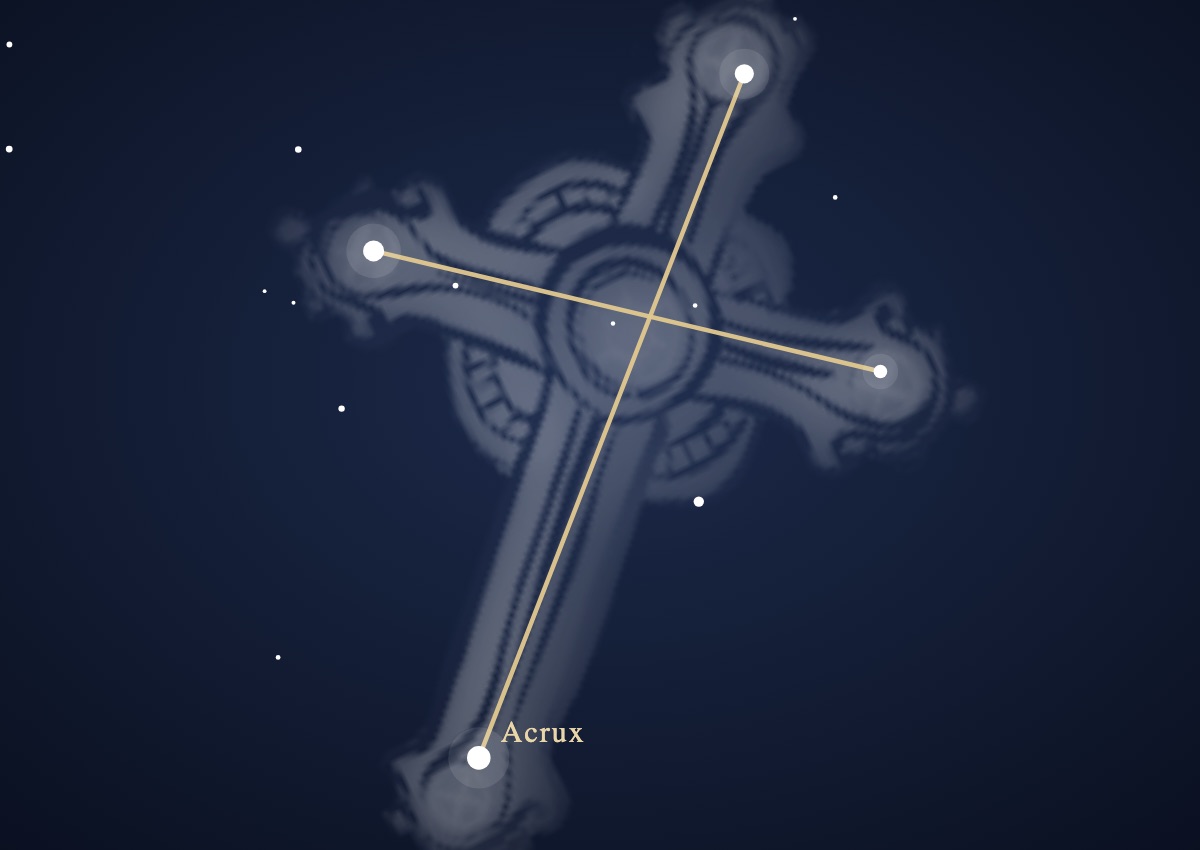
The constellation Crux (Southern Cross) is the centrepiece of the southern hemisphere: the smallest of all constellations, but the best-known and most admired of the southern hemisphere. Its four brightest stars, α Crucis (Acrux), β Crucis (Becrux), γ Crucis (Gacrux) and δ Crucis (Decrux), form a cross that is visible to the naked eye. It is the most suitable group of stars for finding the south celestial pole: if you extend the line from γ Crucis to α Crucis by about four and a half times its length, you arrive almost exactly at the south celestial pole.
The constellation lies within the Milky Way, in a region with many bright stars, and has a lot to offer for stargazers. α Crucis and β Crucis are in 13th and 19th place in the list of the brightest stars. Close to the sapphire-blue β Crucis, also called Mimosa, there appears to be a blood-red carbon star, which in reality is much further away. Further east, between α Crucis and β Crucis, lies the famous Coalsack, a dark cloud of gas and dust at a distance of more than 500 light years. It looks like a hole in the brightly shining Milky Way. Not far from β Crucis there is also a beautiful open star cluster, the “Jewel Box” NGC 4755. Through binoculars it offers a magnificent view of about 50 bright stars, including blue supergiants and, as a special highlight, a glowing red giant in the centre.
History
Because of the precession of the Earth's axis, the Southern Cross stood further north in the sky in ancient times, and in the southern Mediterranean it could still be seen just above the southern horizon until the early Middle Ages. Today it can only be seen in full south of about 25 degrees north latitude. Precession arises because the Sun and the Moon pull on the flattened, rotating Earth; in the process, the Earth's axis traces out a cone once in about 25,800 years. At the time of the crucifixion of Christ, the Southern Cross was probably on the horizon. According to old records, it was known in Alexandria as “Thronus Caesaris” in honour of the Emperor Augustus (63 BC – AD 14).
Although this group of stars had been known for thousands of years, it was never given a constellation of its own. The Greeks saw in it the hind legs of Centaurus. It was only in the 16th century that European sailors recognised in it a cross, the symbol of their faith, and used it as a guide to the south celestial pole. According to old records, the constellation was first shown at the end of the 16th century on a celestial globe by Petrus Plancius (astronomer, theologian and cartographer, 1552–1622). The Southern Cross appears on the flags of Australia, Brazil, New Zealand, Papua New Guinea and Samoa.