Fact sheet
- Latin name
- Triangulum (Tri)
- Brightest star
- β Trianguli (β Tri)
- Relative brightness
- 3.00 mag
- Hipparcos catalogue
- HIP 10064
- Area
- 132 deg² (rank: 78 out of 88)
- Right ascension
- 1h 31m 28s to 2h 50m 40s
- Declination
- +25° 36' 18'' to +37° 20' 50''
- Neighbouring constellations
- Andromeda, Pisces, Aries, Perseus
Visibility
The constellation Triangulum
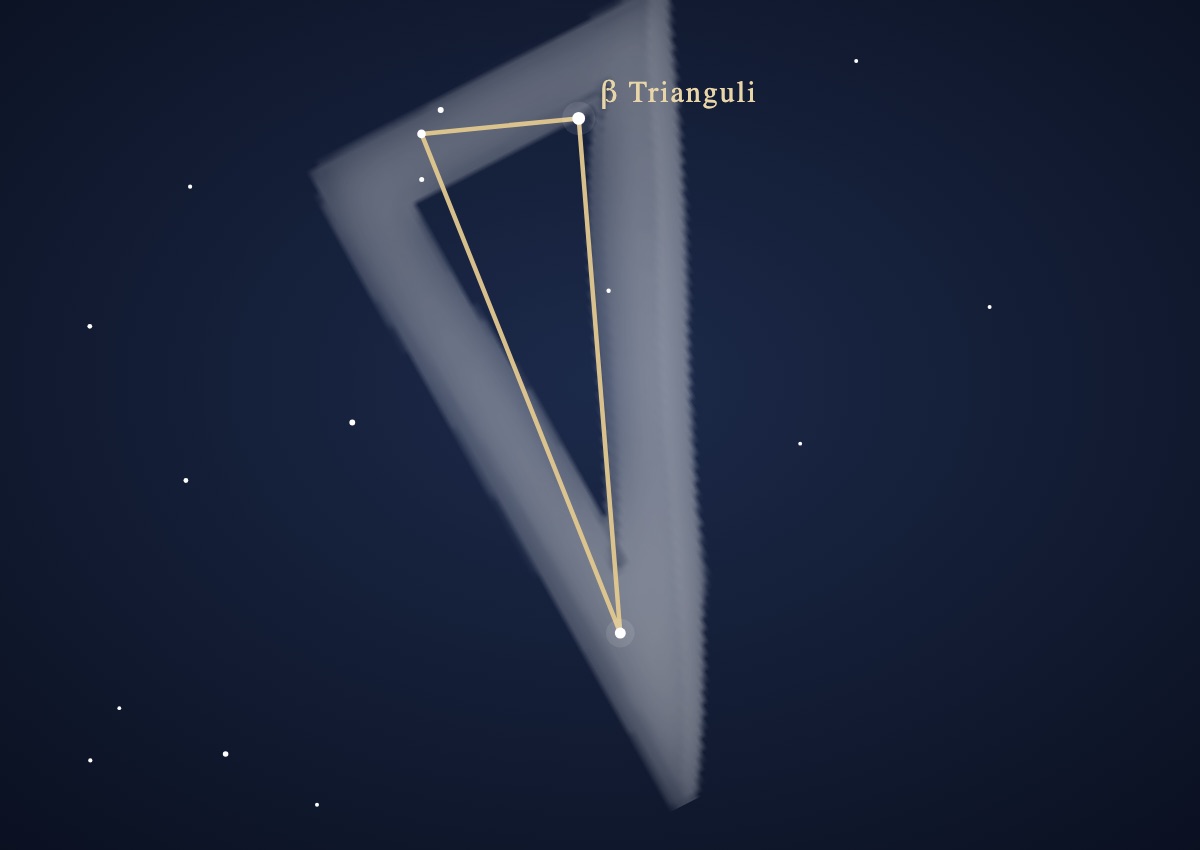
Triangulum is a constellation of the northern hemisphere. Its brightest star is the star β Trianguli, which forms an acute-angled triangle together with the stars α Trianguli and γ Trianguli. It is also often called the northern triangle. This is because there is a similar constellation in the southern night sky, the constellation Triangulum Australe.
Within the constellation Triangulum lies the spiral galaxy M 33, a disc-shaped collection of stars, gas nebulae and other stellar objects. It is around 2.7 million light years away and, after Andromeda and the Milky Way, the third largest galaxy of the Local Group. The spiral galaxy M 33 is also called the Triangulum Nebula. It is a good starting point for amateur astronomers, because no brighter stars distract from this object. Under ideal conditions, the Triangulum Nebula can be seen with the naked eye. On most nights, however, you need at least a good pair of binoculars.
History and mythology
The constellation Triangulum is one of the 48 original constellations of Ptolemy, a mathematician, astronomer, astrologer and geographer of the ancient world. Although it is therefore one of the classical constellations of antiquity, there is hardly any mythology worth mentioning about this constellation.
The Greeks knew this constellation by the name Deltoton, because it looks somewhat like the capital letter delta.
Hyginus, on the other hand, regarded the constellation as the island of Sicily in his astronomical and mythographical handbook “De astronomia” (towards the end of the 1st century BC). Because of its shape, the island of Sicily was also called Trinacria at that time. The Trinacria symbol consists of the head of a girl with three bent legs coming out of it. At first the girl's head represented the head of Medusa with her snake hair, and later the head of Ceres, the goddess of agriculture and fertility. In addition to the three legs, three ears of wheat also come out of the head. They symbolise fertility. The Trinacria is still the symbol of Sicily today and can be seen on its flag.
A second, smaller triangle was created by Johannes Hevelius (1611–1687), astronomer and founder of the mapping of the Moon, from three fainter stars south-east of the large triangle. However, this triangle did not become established over the centuries.