Fact sheet
- Latin name
- Carina (Car)
- Brightest star
- Canopus (α Car)
- Relative brightness
- -0.62 mag
- Hipparcos catalogue
- HIP 30438
- Area
- 494 deg² (rank: 34 out of 88)
- Right ascension
- 6h 02m 46s to 11h 20m 37s
- Declination
- -75° 41' 02'' to -50° 45' 16''
- Neighbouring constellations
- Vela, Puppis, Pictor, Volans, Chamaeleon, Musca, Centaurus
Visibility
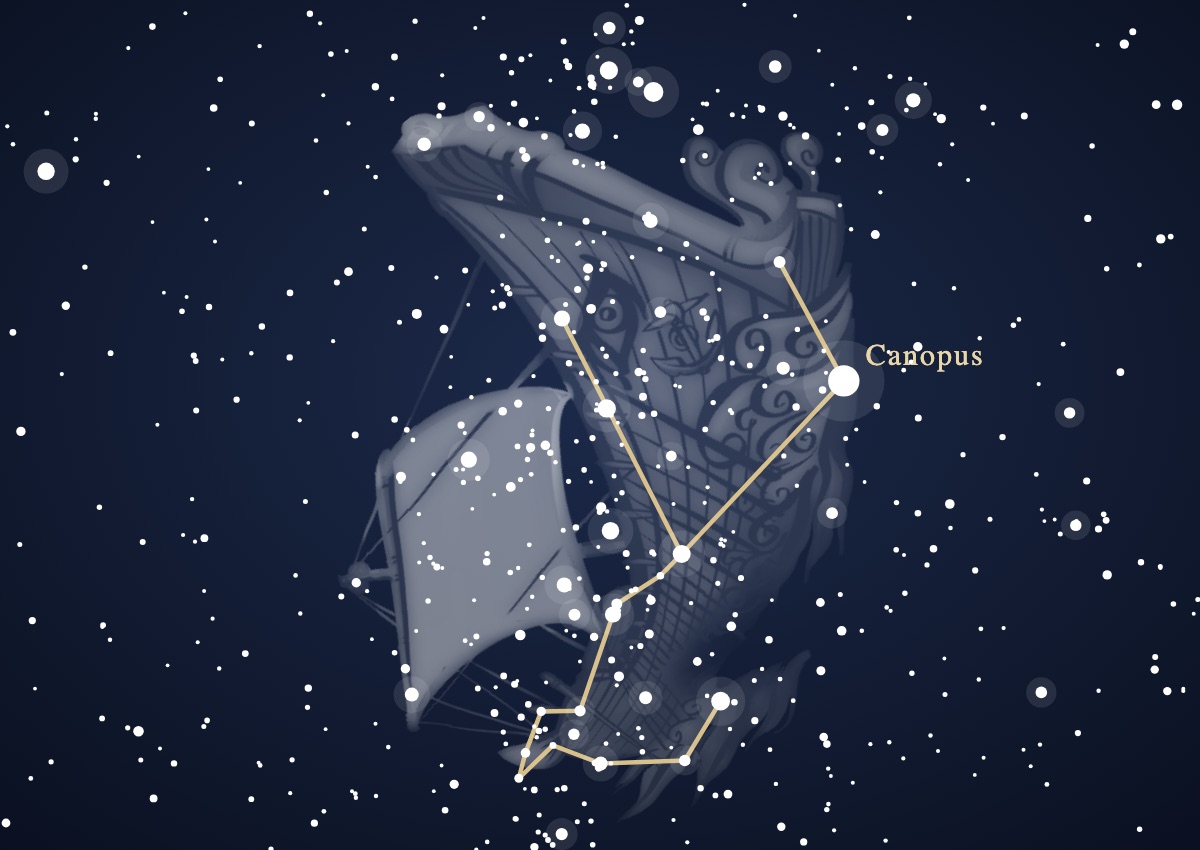
The constellation Carina
Carina is a constellation of the southern hemisphere. Until the 18th century, it was part of the constellation of the mighty ship Argo. In 1756, Nicolas-Louis de Lacaille divided it on a star chart into three parts: the keel (Carina), the afterdeck (Puppis) and the sails (Vela) of the ship. The division was finally fixed in 1763 in his star catalogue. Its brightest star, Canopus, the second brightest star in the sky after Sirius, is named after Canopus, the helmsman of Menelaus.
Mythology
The first part of the myth is written down in the constellation Puppis.
The ship Argo and the Argonauts (Part 2) – With the help of the goddess Athena (among other things, goddess of wisdom, strategy and battle), Argus built a ship with 50 oars and a bow made from a beam from the oracle of Zeus. The beam could speak and gave the Argonauts instructions during the voyage. Jason called on the 50 greatest heroes of Greek history to accompany him. Among them were Hercules (constellation Hercules), King Cepheus of Tegea, the musician Orpheus (constellation Lyra) and the two pairs of twins Castor and Pollux and Lynceus and Idas (constellations Gemini and Lynx). From Jason's home town of Iolcus (on the Pagasetic Gulf), the heroes set off for the Black Sea while Orpheus sang. Their first stop took them to Pelion (on the Aegean Sea) to say goodbye to the centaur Chiron. They continued along the coast, around Chalkidiki, to the island of Lemnos. There, almost all the male inhabitants had been killed by their wives. Only the father of Queen Hypsipyle had survived, because he had hidden. The goddess Aphrodite felt that her sanctuaries on Lemnos were being neglected and therefore punished all the women of the island with bad breath. Their husbands then amused themselves with Thracian slave women and were killed by their jealous wives. Shortly afterwards, the Argonauts landed and spent several months amusing themselves with the women of the island. Jason made Queen Hypsipyle pregnant, and she gave birth to the twins Euneus (later king of Lemnos) and Deipylus. Jason swore to be faithful to her forever. But soon the Argonauts moved on, and Jason forgot his oath. They sailed on through the Sea of Marmara. At Cyzicus they were attacked by six-armed giants (the Gegenees), and in Bithynia they had to compete in a boxing match with King Amycus. He forced all strangers to take part in this fight, but this time Pollux killed the king. As they sailed on, they also rescued the starving old man Phineus, who was being prevented from eating by the Harpies (hybrid creatures with the body of a bird and the head of a woman).
The third part of the myth is written down in the constellation Vela.