Fact sheet
- Latin name
- Cepheus (Cep)
- Brightest star
- Alderamin (α Cep)
- Relative brightness
- 2.45 mag
- Hipparcos catalogue
- HIP 105199
- Area
- 588 deg² (rank: 27 out of 88)
- Right ascension
- 20h 01m 56s to 9h 03m 20s
- Declination
- +53° 21' 12'' to +88° 41' 46''
- Neighbouring constellations
- Ursa Minor, Draco, Cygnus, Lacerta, Cassiopeia, Camelopardalis
Visibility
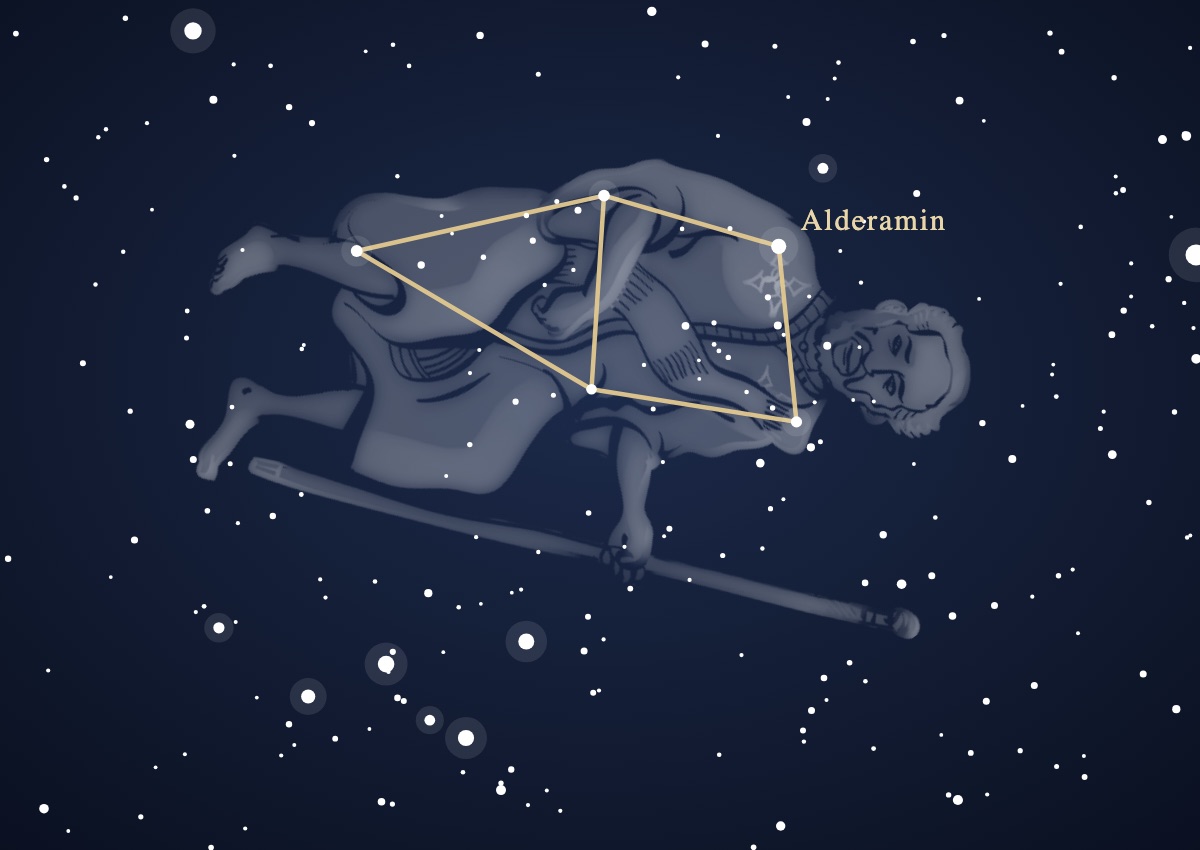
The constellation Cepheus
Cepheus is a constellation of the northern hemisphere. It is circumpolar around the North Pole. This means that its stars are so close to the celestial pole that they never set as seen from Berlin. The constellation is therefore above the horizon all year round there.
Its brightest stars form the shape of a house with a pointed roof. The brightest of them is α Cephei, which bears the Arabic name Alderamin (right arm). The constellation represents King Cepheus. In today's depictions, however, Alderamin no longer marks his right arm but his right shoulder. The star δ Cephei gave the Cepheids their name. The more light these pulsating stars emit, the more slowly they brighten and dim (δ Cephei: 5.4 days). They are used to measure distances to other galaxies.
Mythology
According to Greek mythology, Cepheus was the king of Ethiopia. He was a descendant of the nymph Io, who was a lover of Zeus. Cepheus was married to the vain Cassiopeia, who boasted everywhere that she was even more beautiful than the Nereids, the fifty daughters of the sea god Nereus. In response, the sea god Poseidon, who was married to one of the Nereids, sent the sea monster Cetus to the coast of Cepheus's kingdom. Cepheus turned to the oracle of Ammon for help. The oracle told him to chain his daughter Andromeda to a rock and sacrifice her to the monster. Only in this way could the destruction off his coast be stopped. In his despair, Cepheus followed the oracle's advice. However, Andromeda was rescued just in time by the hero Perseus. Perseus then asked for Andromeda's hand in marriage. Although Andromeda had already been promised to her uncle Phineus, Cepheus agreed. In the end, a fight broke out between Perseus and Phineus at the wedding celebration. During this fight, Perseus held out the head of Medusa towards Phineus. Phineus was turned to stone on the spot.
Cepheus, Cassiopeia, Andromeda, Perseus and the monster Cetus (whale) were later placed in the sky as constellations.