Fact sheet
- Latin name
- Draco (Dra)
- Brightest star
- Eltanin (γ Dra)
- Relative brightness
- 2.23 mag
- Hipparcos catalogue
- HIP 87833
- Area
- 1,083 deg² (rank: 8 out of 88)
- Right ascension
- 9h 22m 28s to 20h 54m 49s
- Declination
- +47° 32' 51'' to +86° 27' 56''
- Neighbouring constellations
- Ursa Minor, Camelopardalis, Ursa Major, Boötes, Hercules, Lyra, Cygnus, Cepheus
Visibility
The constellation Draco
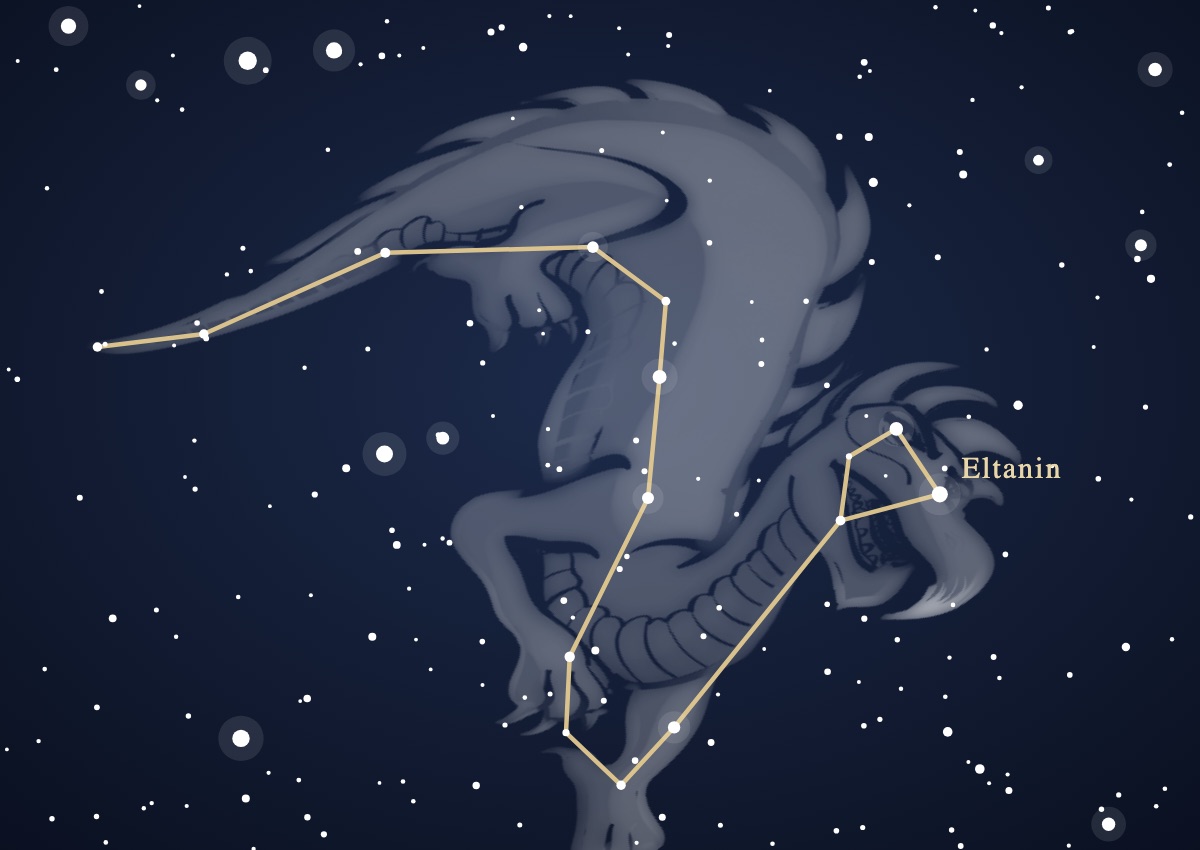
Draco is a constellation of the northern hemisphere. It is circumpolar around the North Pole. This means that its stars are so close to the celestial pole that they never set as seen from Berlin. The constellation is therefore above the horizon all year round there. Its brightest star is γ Draconis, which bears the Arabic name Eltanin (dragon's head).
About 5,000 years ago, α Draconis (Thuban) was the pole star, because, being so close to the North Pole, it was the only star that always stood in the same place in the sky. Because of the wobble of the Earth's axis, today α Ursae Minoris (Polaris) in Ursa Minor is the pole star. Draco is very closely connected with this constellation: in ancient Greece, Ursa Minor is said to have been part of Draco and to have represented the wings of the dragon.
Mythology
Hercules was an illegitimate son of Zeus and Alcmene, the most beautiful and most intelligent woman on Earth. Zeus's deceived wife Hera wanted to get rid of him out of jealousy, his cousin King Eurystheus out of fear for his throne. When Hercules, as a grown man, refused to serve Eurystheus, Hera drove him mad, and he killed his wife and his three children. To obtain forgiveness, he followed the advice of the oracle of Delphi and reluctantly served King Eurystheus for twelve years.
Eurystheus gave him twelve tasks, the Twelve Labours of Hercules, which he was ideally not supposed to survive. The eleventh was to pick the golden apples of the Hesperides. The apples, which promised immortality and eternal youth, were a wedding gift from the earth goddess Gaia to Hera. They were guarded by the Hesperides, the daughters of the giant Atlas, who carried the sky on his shoulders, and by the dragon Ladon, a terrible monster with 100 heads. There are two versions of how Hercules obtained the apples. In the first, he persuaded Atlas to fetch the apples for him, and in return took over the weight of the sky for a while. Because Ladon knew Atlas, Atlas was able to take the apples without any problems. Overjoyed at his new freedom, Atlas now wanted to take them to King Eurystheus himself. But Hercules, who only pretended to agree, persuaded him to take over the weight once more for a short time, and then ran away. In the second account, Hercules defeated Ladon with his poisoned arrows. The Hesperides were endlessly sad about his death, and Hera placed the dragon in the sky in its memory.