Fact sheet
- Latin name
- Monoceros (Mon)
- Brightest star
- β Monocerotis (β Mon)
- Relative brightness
- 4.60 mag
- Hipparcos catalogue
- HIP 30867
- Area
- 482 deg² (rank: 35 out of 88)
- Right ascension
- 5h 55m 52s to 8h 11m 24s
- Declination
- -11° 22' 08'' to +11° 56' 00''
- Neighbouring constellations
- Gemini, Orion, Lepus, Canis Major, Puppis, Hydra, Canis Minor
Visibility
The constellation Monoceros
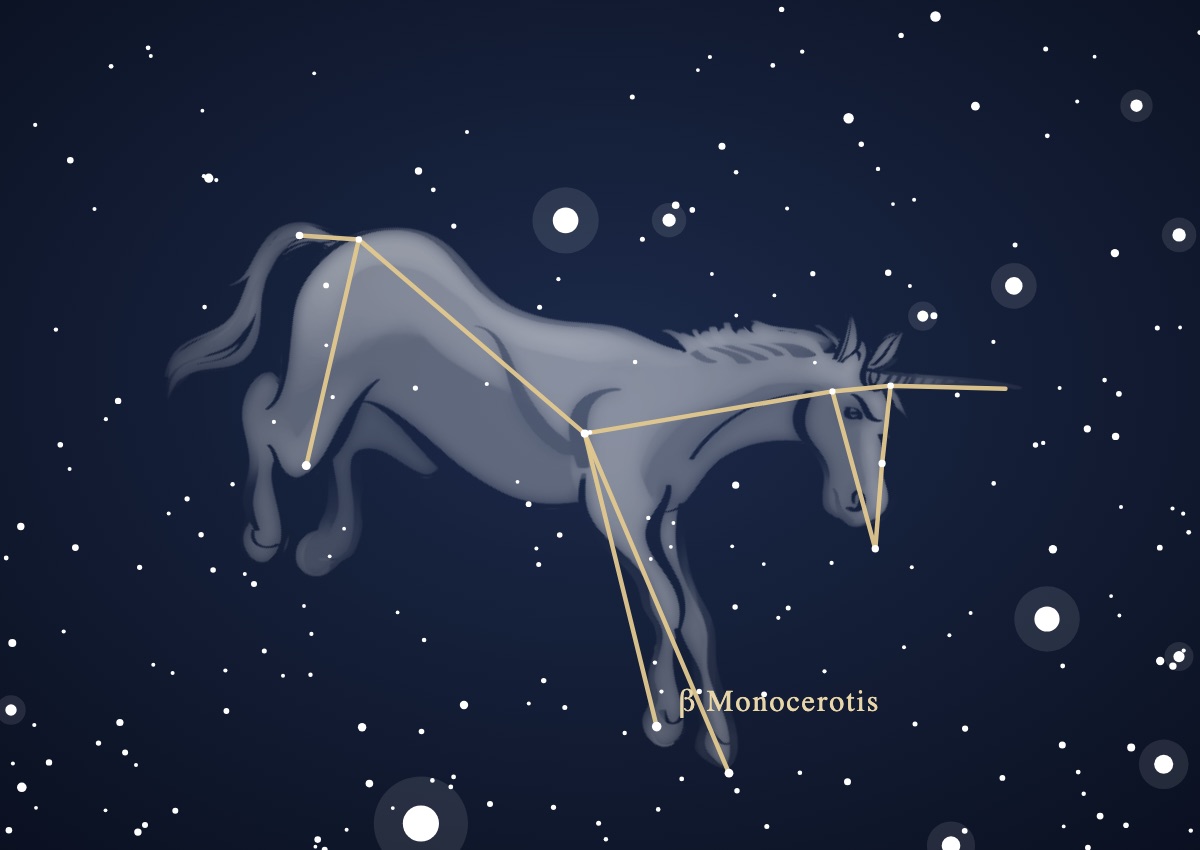
Monoceros is a constellation of the northern and the southern hemisphere. It can therefore be observed from anywhere in the world. Its brightest star is β Monocerotis, which represents the right front hoof of the unicorn.
Although the constellation Monoceros consists only of relatively faint stars, it is fairly easy to find. This is because it lies in the middle of the well-known star pattern called the Winter Triangle. This is a pattern of three stars that is very easy to see in winter and that together form a nearly equilateral triangle. It is formed by the stars Procyon (in the constellation Canis Minor), Sirius (in the constellation Canis Major) and Betelgeuse (in the constellation Orion).
In addition, even amateur astronomers can discover a lot in this constellation. Because the Milky Way runs through it, it contains a large number of open clusters and galactic nebulae. Particularly worth mentioning are the open cluster M 50, which consists of about 100 stars, and the open cluster NGC 2244, which lies in the famous Rosette Nebula. The Rosette Nebula is a cloud of gas that glows because of many young and bright stars. Both star clusters can already be explored with binoculars.
History
In 1612, the Dutch theologian, astronomer and cartographer Petrus Plancius designed a celestial globe that showed several new constellations without any bright stars. On it he introduced Monoceros, together with Camelopardalis; Columba also goes back to him. Whether Plancius was thinking of the Bible is not recorded; however, the unicorn had long been a Christian symbol of purity. In 1624, Jacob Bartsch included Monoceros and Camelopardalis in his star chart and made them known. He interpreted the unicorn as a biblical animal.
This interpretation is supported by the fact that the unicorn is mentioned in several places in the Old Testament. However, the unicorn mentioned in the Old Testament is probably the result of a translation error. In the Greek translation, the Hebrew word "Re'em" was translated as unicorn. In fact, however, the aurochs was probably meant. In old drawings, the aurochs was often shown from the side, so that only one horn could be seen instead of its two horns. The unicorn of the Bible can therefore probably be traced back to a completely ordinary, real animal.