Fact sheet
- Latin name
- Chamaeleon (Cha)
- Brightest star
- α Chamaeleontis (α Cha)
- Relative brightness
- 4.06 mag
- Hipparcos catalogue
- HIP 40702
- Area
- 132 deg² (rank: 79 out of 88)
- Right ascension
- 7h 26m 37s to 13h 56m 27s
- Declination
- -83° 11' 46'' to -75° 17' 24''
- Neighbouring constellations
- Carina, Volans, Mensa, Octans, Apus, Musca
Visibility
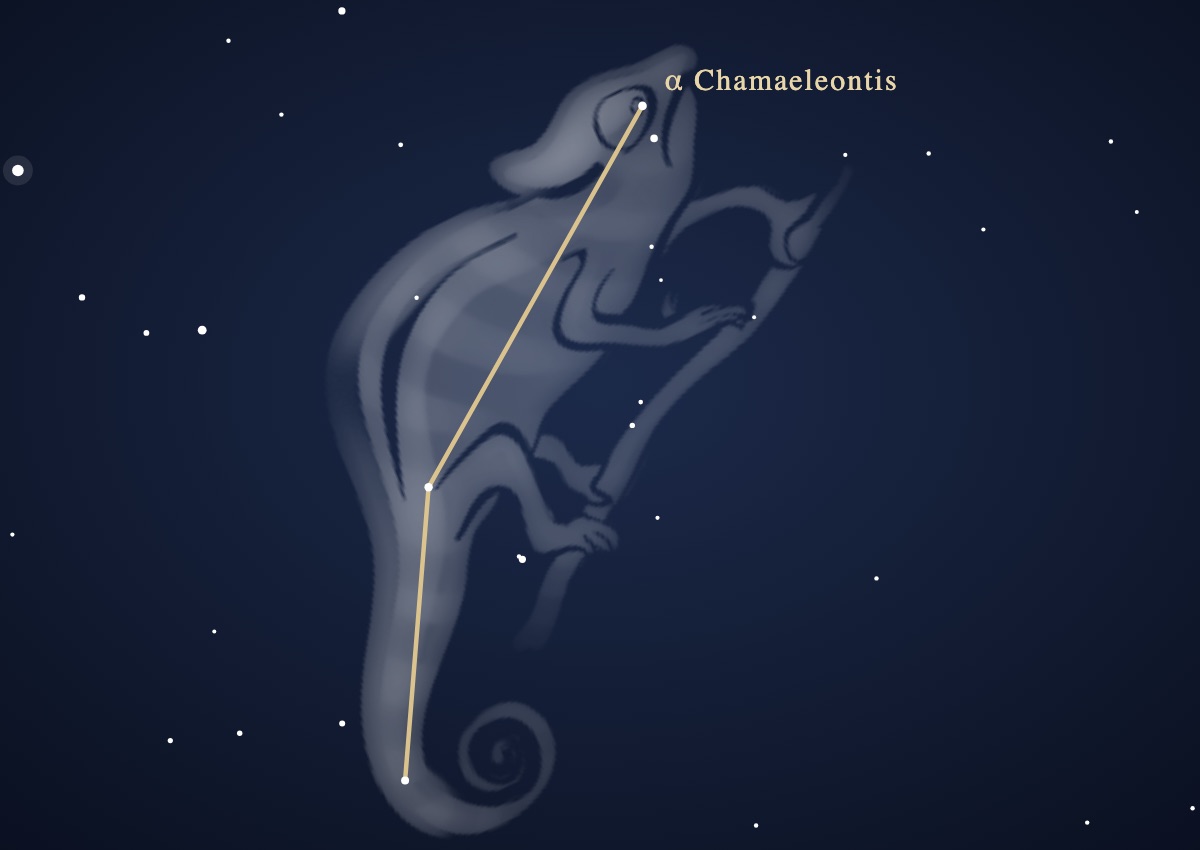
The constellation Chamaeleon
Chamaeleon is a constellation of the southern hemisphere. It is circumpolar around the South Pole. This means that its stars are so close to the celestial pole that they never set as seen from Sydney. The constellation is therefore above the horizon all year round there. Its brightest star, α Chamaeleontis, represents the eye of the chameleon.
The constellation Chamaeleon lies south of the constellation Crux (Southern Cross), right next to the south celestial pole. As early as the 16th century, the Southern Cross served seafarers as a point of orientation. Its stars form a cross that is visible to the naked eye.
History
While the constellations of the northern hemisphere have been known since ancient times and are based on many different mythologies, many constellations of the southern hemisphere remained unnamed for a long time. It was not until the 16th century that people began to deal with them. Between 1595 and 1597, the Dutch seafarers Pieter Dirkszoon Keyser (chief navigator) and Frederick de Houtman (brother of the captain) mapped the southern sky on an expedition on behalf of Petrus Plancius. Influenced by their experiences on their voyage to the East Indies, they named a dozen constellations: Chamaeleon, Musca, Volans, Indus, Grus, Apus, Pavo, Phoenix, Dorado, Hydrus, Triangulum Australe and Tucana.
On star charts published shortly before 1600, the chameleon was shown with its tongue shooting out. The two Dutch seafarers probably connected it with its neighbouring constellation Musca (Fly), which was later called Bee for almost two centuries. It can be assumed that they encountered this iguana-like creature in Madagascar in 1595 and were so fascinated by its shooting tongue that they named one constellation after this animal and another constellation after its prey. It may also be no coincidence that they gave the chameleon the less conspicuous of the two constellations. After all, the chameleon is able to adapt very well to its surroundings and to surprise its prey out of nowhere. However, the constellation Chamaeleon will not always remain less conspicuous than its prey. Several molecular clouds extend through the eastern part of the constellation. They contain enough matter for thousands of new stars and have already formed hundreds of star embryos. When these “baby stars” shine brightly enough in a few million years, the chameleon will be almost as interesting as its prey.