Fact sheet
- Latin name
- Pavo (Pav)
- Brightest star
- Peacock (α Pav)
- Relative brightness
- 1.94 mag
- Hipparcos catalogue
- HIP 100751
- Area
- 378 deg² (rank: 44 out of 88)
- Right ascension
- 17h 40m 40s to 21h 32m 44s
- Declination
- -74° 58' 28'' to -56° 35' 19''
- Neighbouring constellations
- Telescopium, Ara, Apus, Octans, Indus
Visibility
The constellation Pavo
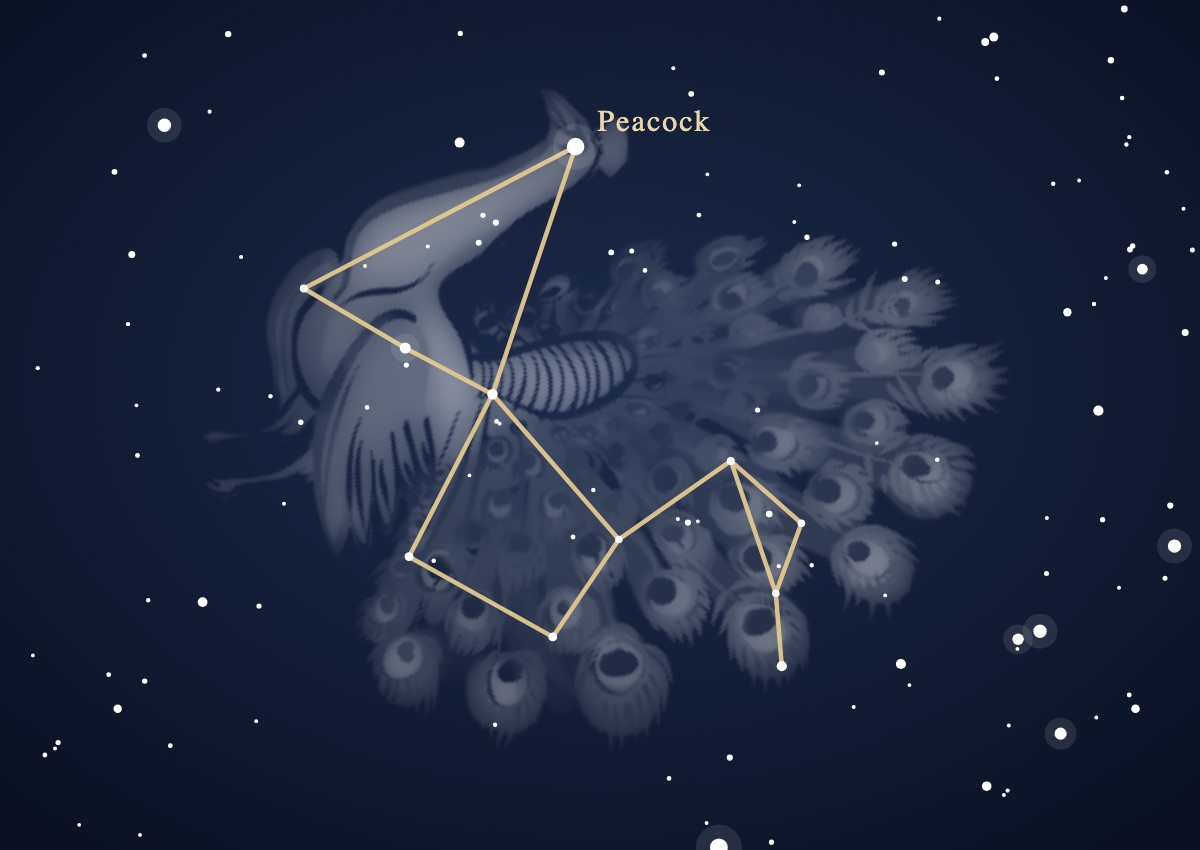
Pavo is a constellation of the southern hemisphere. It is circumpolar around the South Pole. This means that its stars are so close to the celestial pole that they never set as seen from Sydney. The constellation is therefore above the horizon all year round there. Its brightest star, α Pavonis, is also known as Peacock and, with its impressive brightness, represents the shining eye of the peacock.
History
While the constellations of the northern hemisphere have been known since ancient times and are based on many different mythologies, many constellations of the southern hemisphere remained unnamed for a long time. It was not until the 16th century that people turned their attention to them. Between 1595 and 1597, the Dutch seafarers Pieter Dirkszoon Keyser (chief navigator) and Frederick de Houtman (brother of the captain) mapped the southern sky on an expedition on behalf of Petrus Plancius. Influenced by their experiences on their voyage to the East Indies, they named a dozen constellations: Chamaeleon, Musca, Volans, Indus, Grus, Apus, Pavo, Phoenix, Dorado, Hydrus, Triangulum Australe and Tucana. The exotic peacocks of South-East Asia had made such a strong impression on the Dutch seafarers that they recognised this wonderful animal in the night sky. Johann Bayer included the constellation in his celestial atlas Uranometria in 1603.
Mythology
Pavo is one of the few southern constellations that can draw on a Greek myth. According to the written sources, Zeus had fallen in love with Io, the daughter of the river god Inachus. To hide her from his jealous wife Hera, he turned her into a white cow. But Hera saw through the plan and demanded the cow as a present. In order not to arouse suspicion, Zeus had to grant her wish. Hera ordered the giant Argus to guard her husband's beloved at all times. Argus had 100 eyes, of which only two were ever asleep. Zeus then sent his son Hermes to free Io. Hermes sent Argus to sleep by playing the flute and cut off his head. Io was able to escape and soon afterwards got back her human form. As a special honour, Hera placed the eyes of Argus on the feathers of the peacock, because in mythology peacocks were the sacred animals of Hera. Their majestic pattern is still a special feature of these birds today.