Fact sheet
- Latin name
- Musca (Mus)
- Brightest star
- α Muscae (α Mus)
- Relative brightness
- 2.69 mag
- Hipparcos catalogue
- HIP 61585
- Area
- 138 deg² (rank: 77 out of 88)
- Right ascension
- 11h 19m 26s to 13h 51m 08s
- Declination
- -75° 41' 46'' to -64° 38' 17''
- Neighbouring constellations
- Crux, Centaurus, Carina, Chamaeleon, Apus, Circinus
Visibility
The constellation Musca
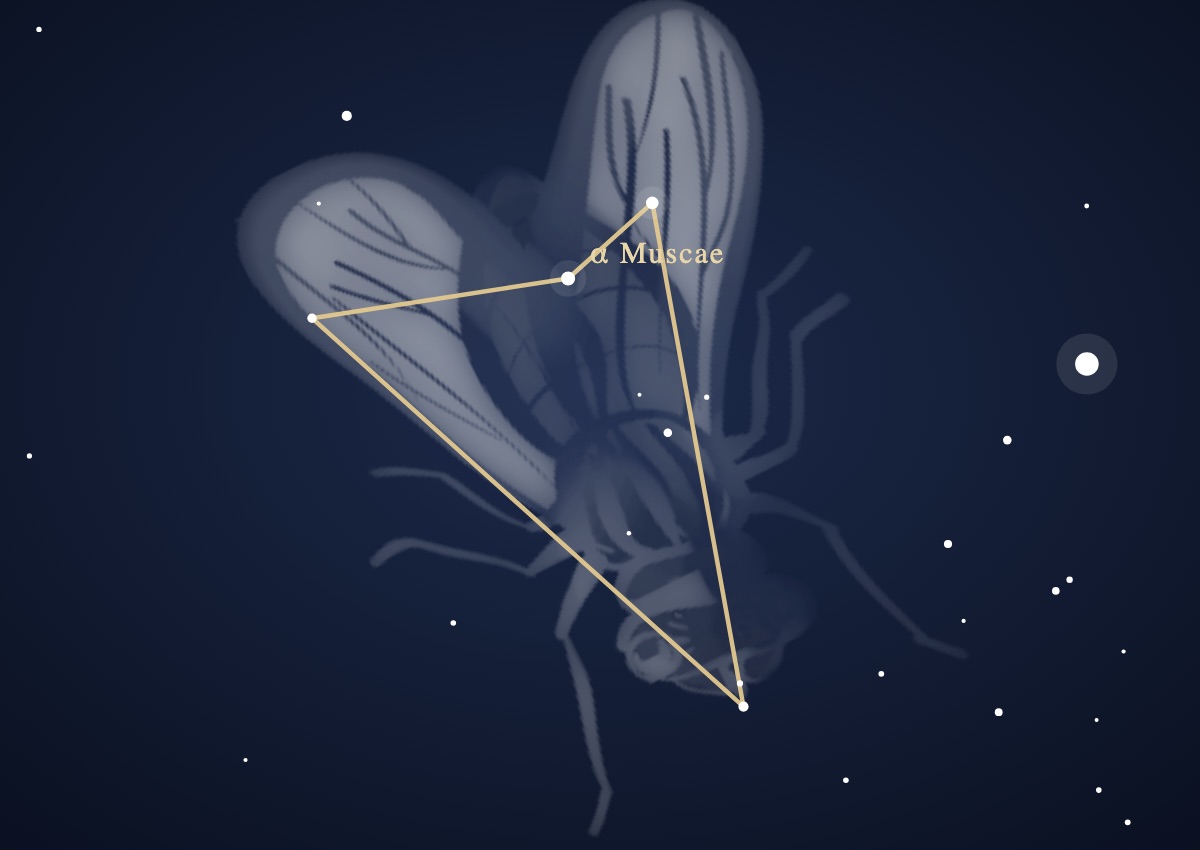
Musca (fly) is a constellation of the southern hemisphere. It is circumpolar around the South Pole. This means that its stars are so close to the celestial pole that they never set as seen from Sydney. The constellation is therefore above the horizon all year round there. Its brightest star is α Muscae.
The constellation Musca lies directly south of the striking constellation Crux (Southern Cross) and is therefore easy to find in the sky. As early as the 16th century, the Southern Cross served seafarers as a point of orientation. Its stars form a cross that is visible to the naked eye.
History
While the constellations of the northern hemisphere have been known since ancient times and are based on many different mythologies, many constellations of the southern hemisphere remained unnamed for a long time. It was not until the 16th century that people began to deal with them. Between 1595 and 1597, the Dutch seafarers Pieter Dirkszoon Keyser (chief navigator) and Frederick de Houtman (brother of the captain) mapped the southern sky on an expedition on behalf of Petrus Plancius. Influenced by their experiences on their voyage to the East Indies, they named a dozen constellations: Chamaeleon, Musca, Volans, Indus, Grus, Apus, Pavo, Phoenix, Dorado, Hydrus, Triangulum Australe and Tucana.
The two Dutch seafarers originally named the constellation Fly. It was meant to represent the prey of the neighbouring constellation Chamaeleon. In 1603, Johann Bayer turned it into a Bee (Latin: Apis) in his celestial atlas, and it was known by this name for almost two centuries. The French theologian Nicolas-Louis de Lacaille, who worked on astronomy, geodesy and mathematics throughout his life, named it Fly again (“la Mouche”) on his star chart in 1756 and kept this name in his star catalogue “Coelum Australe Stelliferum”, published in 1763. It is often said that he wanted to avoid confusion with the constellation Apus (bird of paradise). There is no evidence for this. At that time there was still a constellation called Northern Fly (Musca Borealis) in the northern hemisphere, near the constellation Aries. However, this constellation no longer exists today, so the name of the southern constellation could be shortened to Fly (Musca).