Fact sheet
- Latin name
- Grus (Gru)
- Brightest star
- Alnair (α Gru)
- Relative brightness
- 1.74 mag
- Hipparcos catalogue
- HIP 109268
- Area
- 366 deg² (rank: 45 out of 88)
- Right ascension
- 21h 27m 43s to 23h 27m 04s
- Declination
- -56° 23' 27'' to -36° 18' 46''
- Neighbouring constellations
- Piscis Austrinus, Microscopium, Indus, Tucana, Phoenix, Sculptor
Visibility
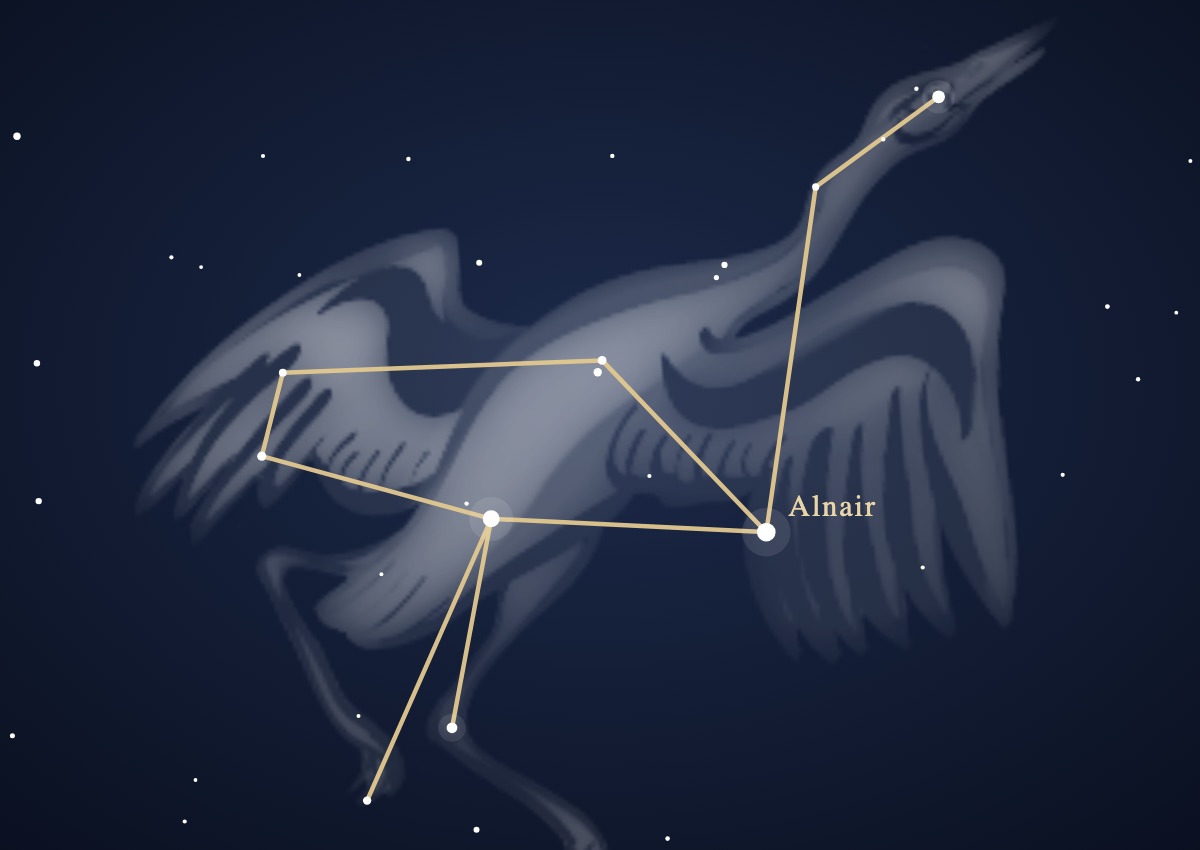
The constellation Grus
Grus is a constellation of the southern hemisphere. Its brightest star bears the Arabic name Alnair (the bright one from the fish's tail). It represents one of the wings of the crane. The brightest star got this name because, until the beginning of the 17th century, it belonged to the constellation Piscis Austrinus.
History
While the constellations of the northern hemisphere have been known since ancient times and are based on many different mythologies, many constellations of the southern hemisphere remained unnamed for a long time. It was not until the 16th century that people began to deal with them. Between 1595 and 1597, the Dutch seafarers Pieter Dirkszoon Keyser (chief navigator) and Frederick de Houtman (brother of the captain) mapped the southern sky on an expedition on behalf of Petrus Plancius. Influenced by their experiences on their voyage to the East Indies, they named a dozen constellations: Chamaeleon, Musca, Volans, Indus, Grus, Apus, Pavo, Phoenix, Dorado, Hydrus, Triangulum Australe and Tucana.
In antiquity, however, the stars of Grus were still counted as part of the constellation Piscis Austrinus, and it was only in 1598 that Petrus Plancius took them up again on his celestial globe as "Krane Grus" (Dutch and Latin for crane). Petrus Plancius knew this bird and this pattern of stars from the records of the two Dutch seafarers Pieter Dirkszoon Keyser and Frederick de Houtman. In 1603, the German astronomer Johannes Bayer included the constellation in his celestial atlas "Uranometria" as the crane. The name "Phoenicopterus" (flamingo), which appeared later and probably also goes back to Plancius, did not become established.