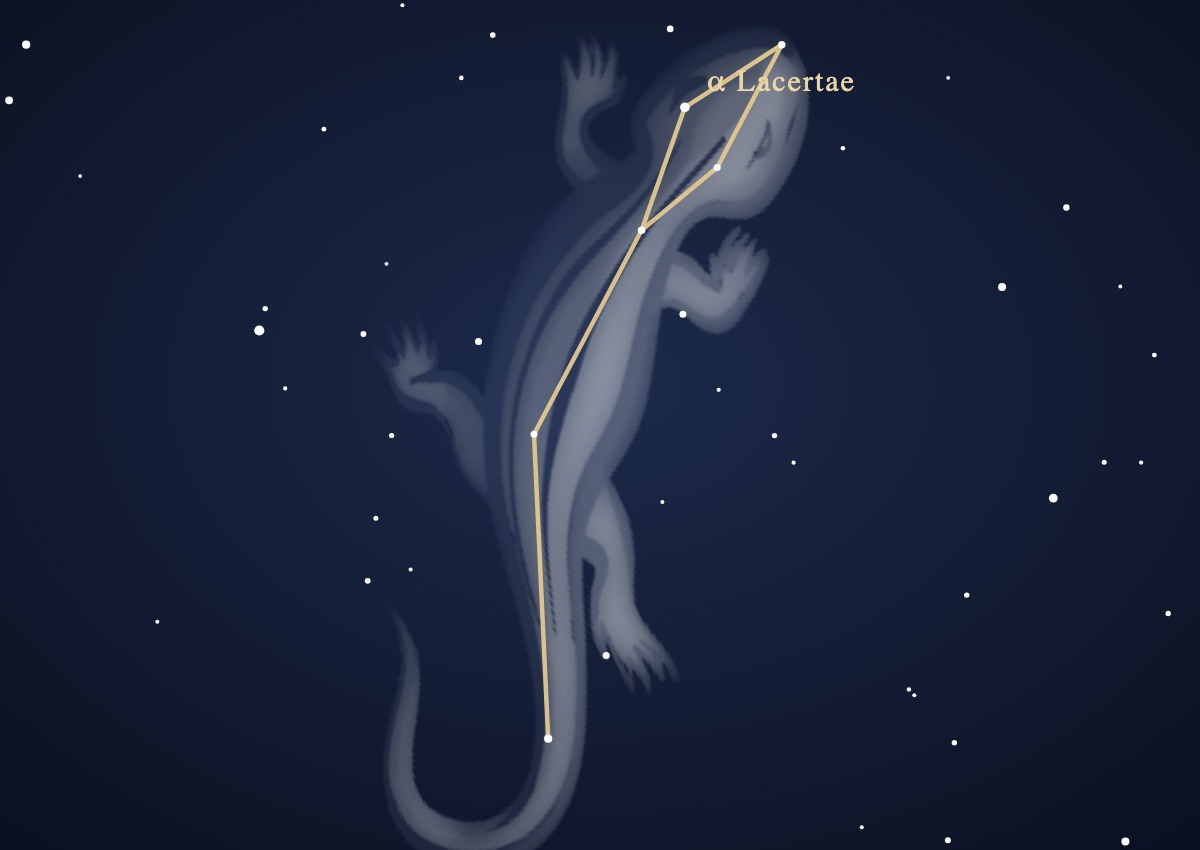
Fact sheet
- Latin name
- Lacerta (Lac)
- Brightest star
- α Lacertae (α Lac)
- Relative brightness
- 3.76 mag
- Hipparcos catalogue
- HIP 111169
- Area
- 201 deg² (rank: 68 out of 88)
- Right ascension
- 21h 57m 30s to 22h 57m 52s
- Declination
- +35° 09' 56'' to +56° 55' 05''
- Neighbouring constellations
- Cepheus, Cygnus, Pegasus, Andromeda, Cassiopeia
Visibility
The constellation Lacerta
Lacerta is a constellation of the northern hemisphere. It is partly circumpolar around the North Pole. This means that some of its stars are so close to the celestial pole that they never set as seen from Berlin. Part of the constellation is therefore above the horizon all year round there. Its brightest star, α Lacertae, forms the head of the lizard together with the stars β Lacertae and 4 Lacertae.
The brightest star of the constellation Lacerta, α Lacertae, lies north-east of the brightest star of the constellation Cygnus, the star Deneb. The constellation Cygnus is also often called the “Northern Cross”. Its five brightest stars form a cross. The brightest of these stars represents the tail of the swan. It is a good starting point for finding the constellation Lacerta. Lacerta became famous through BL Lacertae: in 1929, Cuno Hoffmeister took the object for a variable star. In reality it is the active nucleus of a galaxy around 900 million light years away, after which a whole class of such objects is named today.
History
The constellation Lacerta consists of relatively faint stars. They have no special names, and there are no legends about this part of the sky. The constellation Lacerta was first introduced by Johannes Hevelius (astronomer and founder of the mapping of the Moon) in 1690 in his star atlas “Firmamentum Sobiescianum”. Hevelius gave it the second name “Stellio”, after the hardun (starred agama), a species of lizard. However, this second name did not become established.
Other proposals for naming this constellation did not become established either. For example, as early as 1679 the French astronomer Augustin Royer wanted to name this constellation “Sceptrum (the sceptre)” or “the hand of justice” in honour of the reigning king, Louis XIV. The constellation was meant to represent the hand of Justitia holding the French sceptre.
In 1787 the German astronomer Johann Elert Bode tried to create a memorial to the Prussian king Frederick the Great, who had died shortly before. He called it “Honores Friderici (Frederick's honour)”. But his proposal also failed. Today the constellation is known only as Lacerta (the lizard).