Fact sheet
- Latin name
- Equuleus (Equ)
- Brightest star
- Kitalpha (α Equ)
- Relative brightness
- 3.92 mag
- Hipparcos catalogue
- HIP 104987
- Area
- 72 deg² (rank: 87 out of 88)
- Right ascension
- 20h 56m 11s to 21h 26m 20s
- Declination
- +2° 28' 38'' to +13° 02' 21''
- Neighbouring constellations
- Pegasus, Delphinus, Aquarius
Visibility
The constellation Equuleus
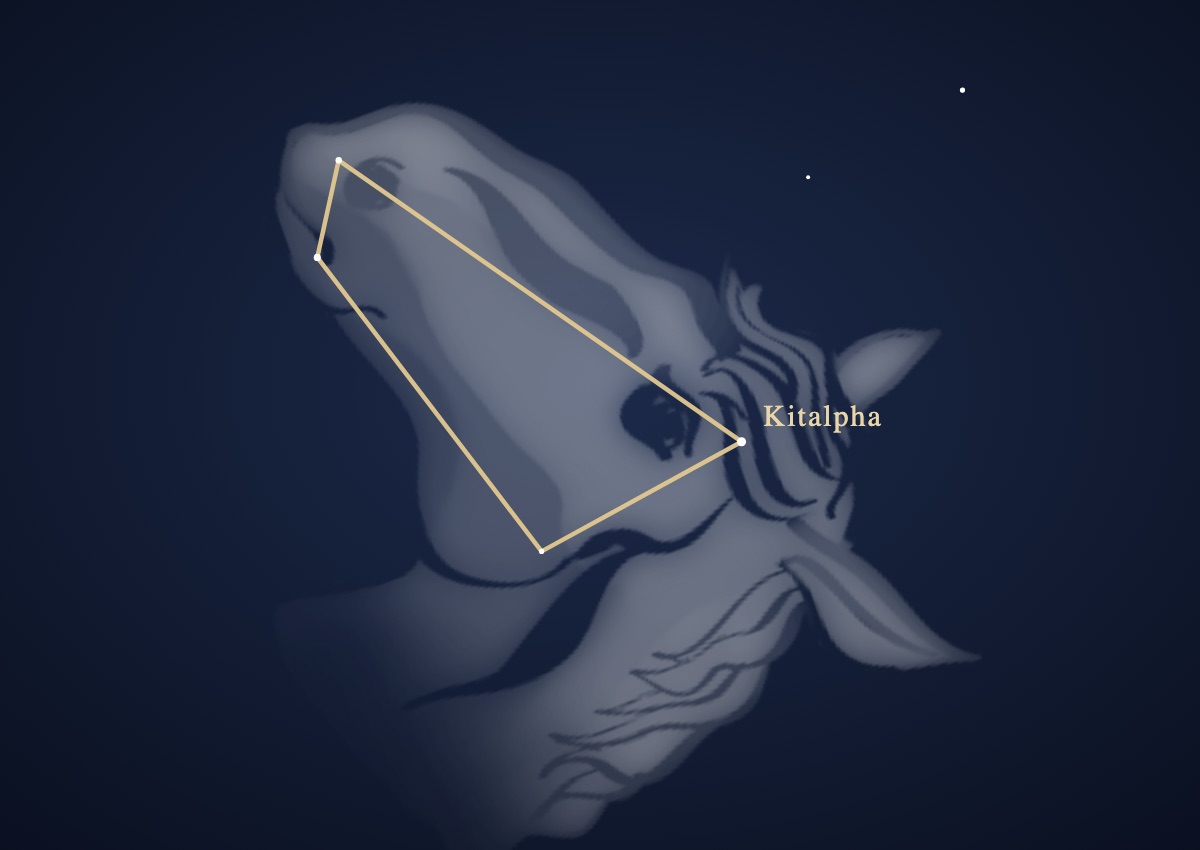
Equuleus (foal) is a constellation of the northern hemisphere. The brightest star of the constellation bears the name Kitalpha (front part of the horse) and represents the head of the horse. The constellation Equuleus “floats” to the west, ahead of its fellow horse, the constellation Pegasus. Equuleus is first attested in Ptolemy (2nd century AD), who probably adopted it from Hipparchus. No genuine ancient legend about it has been handed down; the following story was originally told about Pegasus.
Mythology
Cronus was the leader of the Titans and the youngest son of Gaia (Earth) and Uranus (Sky). He fell in love with Philyra, the daughter of the Titan Oceanus. To hide his identity, he appeared to her only in the form of a horse. In this way they fathered the centaur Chiron. Like all centaurs, Chiron was born with the upper body of a human and the lower body of a horse. Philyra was so shocked by this that she asked Zeus to turn her into a linden tree. Zeus, who was also a son of Cronus and the highest Olympian god, did his father's lover this favour. The centaur Chiron married the naiad Chariclo, a daughter of the god Apollo, and with her he fathered a daughter, Ocyrhoe. She was born with a very special gift, the gift of prophecy, the foretelling of religious messages. One day she was seduced by Aeolus, a grandson of Deucalion (son of the Titan Prometheus and king of Thessaly). To hide her pregnancy from her father, she fled into the mountains. There she gave birth to her daughter Arne, also known as Melanippe. When the centaur Chiron was searching for his daughter, Ocyrhoe begged the gods to turn her into a foal. Artemis, one of the twelve great Olympian deities (among other things goddess of birth and of the moon and protector of women and children), took pity on her and granted her wish. Chiron's daughter Ocyrhoe is also known by the name Hippe or Hippo (Greek for horse). To this day she hides from her father in the sky and only now and then sticks out her head.