Fact sheet
- Latin name
- Pyxis (Pyx)
- Brightest star
- α Pyxidis (α Pyx)
- Relative brightness
- 3.67 mag
- Hipparcos catalogue
- HIP 42828
- Area
- 221 deg² (rank: 65 out of 88)
- Right ascension
- 8h 26m 43s to 9h 27m 37s
- Declination
- -37° 17' 31'' to -17° 24' 41''
- Neighbouring constellations
- Hydra, Puppis, Vela, Antlia
Visibility
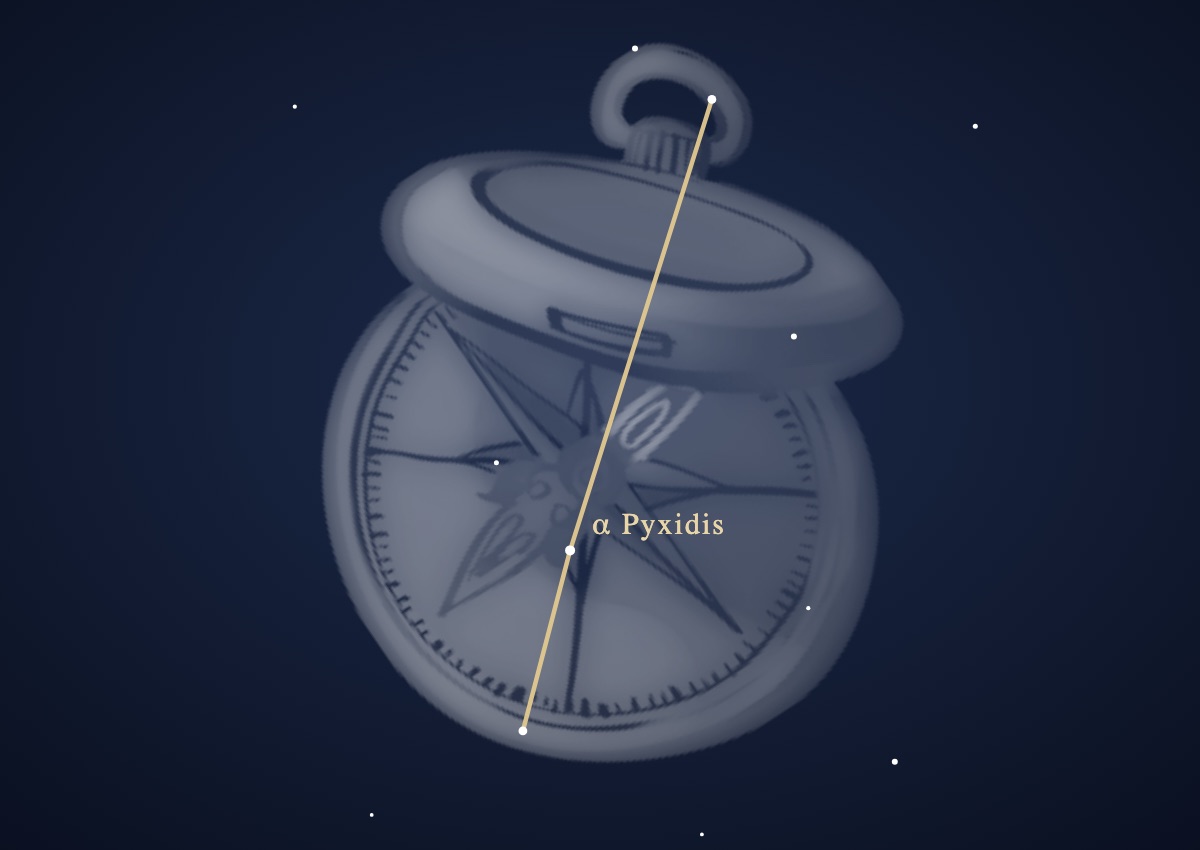
The constellation Pyxis
Pyxis is a constellation of the southern hemisphere. Its brightest star is α Pyxidis. However, its star T Pyxidis is much more interesting to observe. It is a burnt-out star with an apparent magnitude of up to 15.8 mag, which at regular intervals produces a recurrent nova (a sudden increase in brightness on the surface of a white dwarf, caused by the explosive ignition of hydrogen in a double star system). T Pyxidis orbits its still active neighbouring star at such a small distance that it draws gas away from it. When this gas hits the surface of the burnt-out star, thermonuclear explosions occur from time to time. The last novae took place in 1890, 1902, 1920, 1944, 1966 and 2011. At those times, T Pyxidis reached an apparent magnitude of up to 6.5 mag and could be seen in the sky with the naked eye.
History
The French theologian Nicolas-Louis de Lacaille, who devoted his life to astronomy, geodesy and mathematics, introduced 14 new constellations of the southern hemisphere. In 1750, he set off on a four-year journey to the Cape of Good Hope in order to observe, among other things, the constellations of the southern sky. During this time, he catalogued almost 10,000 stars. Nicolas-Louis de Lacaille named most of his new constellations after technical instruments. In this way, the constellations Sculptor, Fornax, Caelum, Antlia, Pictor, Microscopium, Reticulum, Octans, Horologium, Pyxis, Mensa, Telescopium, Norma and Circinus came into being. He also divided the large ancient constellation Argo Navis into the three constellations Carina, Puppis and Vela. His star catalogue of the southern sky was published in 1763, one year after his death, under the title “Coelum Australe Stelliferum”. What his 14 new constellations have in common is that they consist of relatively faint stars.
The ancient Greeks saw the four brightest stars of Pyxis as the mast of the ship Argo, but it was not part of the ancient constellation. However, the ship's compass was not yet known in ancient times, because the first magnetic compass was only used by the Chinese in the 11th century. Nicolas-Louis de Lacaille first introduced the compass in 1756 under the French name “la Boussole” and latinised it in 1763 as “Pyxis Nautica”. Also in 1756, he divided Argo Navis into three separate constellations, because he found it too large and too difficult to survey; the division was finally fixed in 1763 in his star catalogue. This created the keel of the ship (Carina), the poop deck of the ship (Puppis) and the sails of the ship (Vela).