Fact sheet
- Latin name
- Phoenix (Phe)
- Brightest star
- Ankaa (α Phe)
- Relative brightness
- 2.39 mag
- Hipparcos catalogue
- HIP 2081
- Area
- 469 deg² (rank: 37 out of 88)
- Right ascension
- 23h 26m 46s to 2h 25m 03s
- Declination
- -57° 50' 54'' to -39° 18' 14''
- Neighbouring constellations
- Sculptor, Grus, Tucana, Hydrus, Eridanus, Fornax
Visibility
The constellation Phoenix
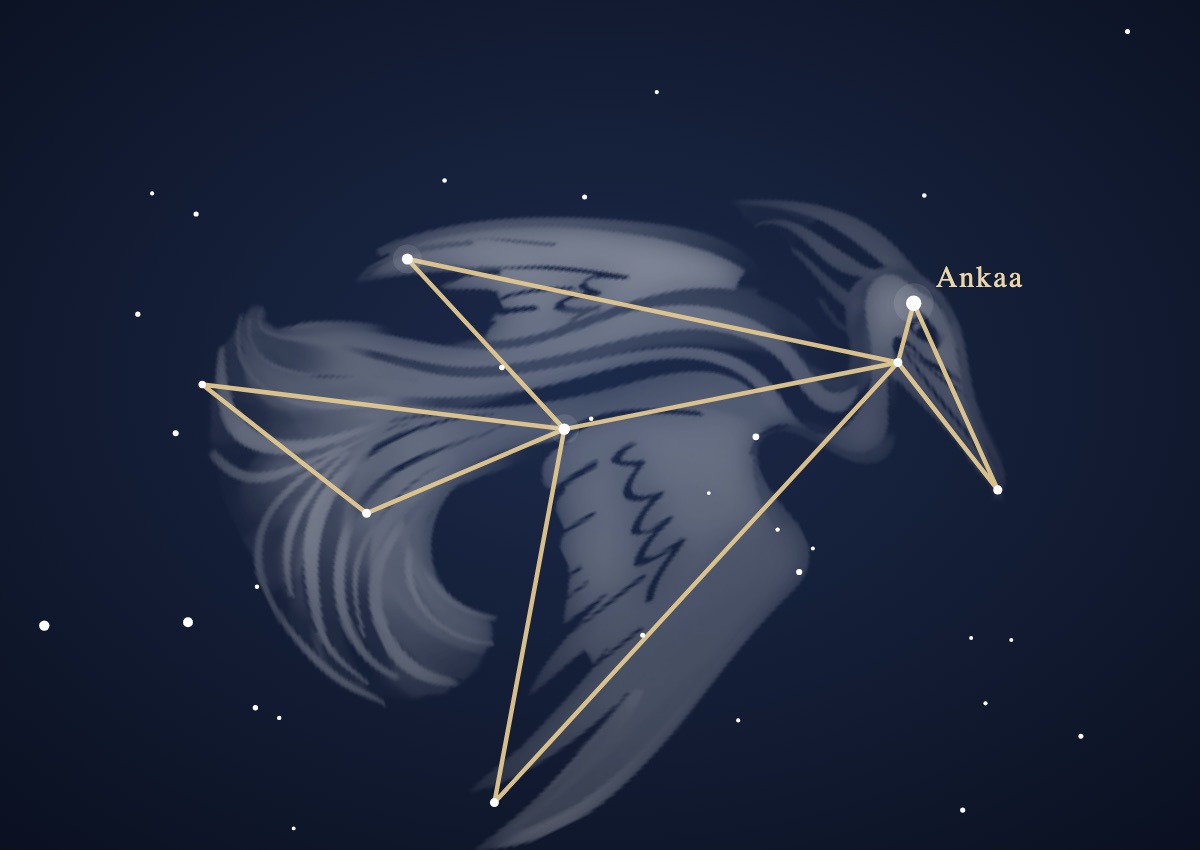
Phoenix is a constellation of the southern hemisphere. Its brightest star is α Phoenicis, also known by the name Ankaa (phoenix). The Phoenix proudly wears its brightest star on its head.
In this part of the night sky, it is one of five constellations that were named after birds. Near it, Pavo, Grus, Tucana and Apus also shine. Below it winds the constellation of the river Eridanus, a particularly long constellation of the southern sky. Its brightest star, Achernar, lies south-east of Phoenix.
History
While the constellations of the northern hemisphere have been known since ancient times and are based on many different mythologies, many constellations of the southern hemisphere remained unnamed for a long time. It was not until the 16th century that people began to deal with them. Between 1595 and 1597, the Dutch seafarers Pieter Dirkszoon Keyser (chief navigator) and Frederick de Houtman (brother of the captain) mapped the southern sky on an expedition on behalf of Petrus Plancius. Influenced by their experiences on their voyage to the East Indies, they named a dozen constellations: Chamaeleon, Musca, Volans, Indus, Grus, Apus, Pavo, Phoenix, Dorado, Hydrus, Triangulum Australe and Tucana.
Mythology
The phoenix was already known at the time of the ancient Egyptians, even though it had not yet been immortalised in the sky. According to mythology, it is said to have been present when the world was created. It was regarded as the soul of the sun god Ra. It is said to have appeared every few hundred years in the form of a heron.
Later, at the time of the Greeks and Romans, it was known as the “phoenix rising from the ashes”. According to the Metamorphoses by Ovid, a phoenix lived for five centuries. During this time it fed only on frankincense and balsam. When it reached the end of its life, it built itself a nest, in which it died and rose again as a small bird.
To this day, the phoenix stands for rising again in new splendour, as well as for rebirth and immortality.