Fact sheet
- Latin name
- Camelopardalis (Cam)
- Brightest star
- β Camelopardalis (β Cam)
- Relative brightness
- 4.02 mag
- Hipparcos catalogue
- HIP 23522
- Area
- 757 deg² (rank: 18 out of 88)
- Right ascension
- 3h 15m 36s to 14h 27m 08s
- Declination
- +52° 39' 56'' to +86° 05' 51''
- Neighbouring constellations
- Ursa Minor, Cepheus, Cassiopeia, Perseus, Auriga, Lynx, Ursa Major, Draco
Visibility
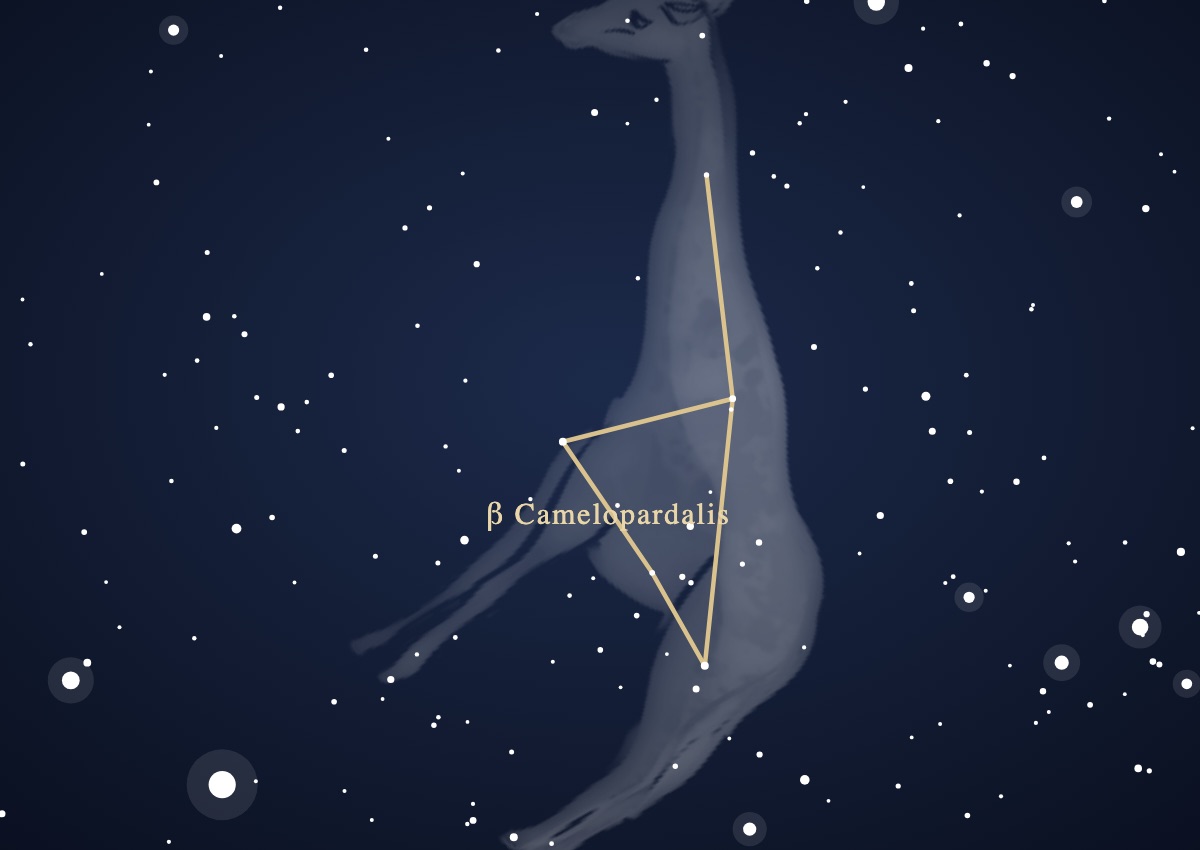
The constellation Camelopardalis
Camelopardalis is a constellation of the northern hemisphere. It is circumpolar around the North Pole. This means that its stars are so close to the celestial pole that they never set as seen from Berlin. The constellation is therefore above the horizon all year round there.
It lies between the prominent constellations Ursa Major, Auriga and Cassiopeia and the Pole Star of the constellation Ursa Minor, exactly where the night sky seems to be empty. Only under the very best conditions is it possible at all for an attentive observer to discover a few stars at this spot with the naked eye.
Its brightest star is β Camelopardalis, which has an apparent magnitude of only 4.02 mag. Even with a small telescope, however, one can see that β Camelopardalis is a so-called optical double star. A yellowish main star at a distance of around 840 light years and a white companion only appear to be close to each other.
History
In 1612, the Dutch theologian, astronomer and cartographer Petrus Plancius designed a celestial globe that showed several new constellations which contained no bright stars.
Jacob Bartsch, who adopted the constellation in 1624, saw in Camelopardalis the camel on which Rebecca rode to her future husband Isaac, the second-born son of Abraham (Gen 24). In ancient times, people thought that a giraffe was a mixture of a camel (camel's head) and a leopard (leopard's spots). For this reason, it still bears the Latin name Camelopardalis today.