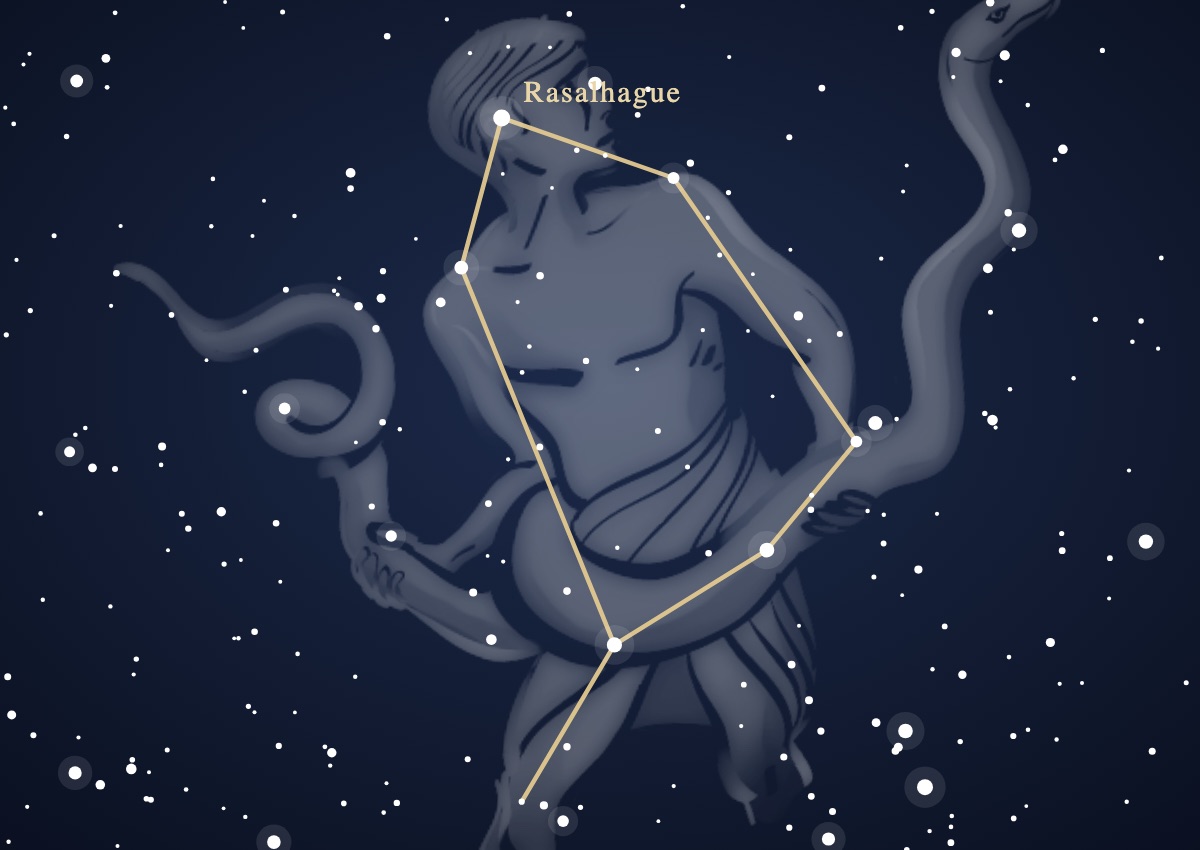
Fact sheet
- Latin name
- Ophiuchus (Oph)
- Brightest star
- Rasalhague (α Oph)
- Relative brightness
- 2.08 mag
- Hipparcos catalogue
- HIP 86032
- Area
- 948 deg² (rank: 11 out of 88)
- Right ascension
- 16h 01m 33s to 18h 45m 50s
- Declination
- -30° 12' 44'' to +14° 23' 15''
- Neighbouring constellations
- Hercules, Serpens, Libra, Scorpius, Sagittarius, Aquila
Visibility
The constellation Ophiuchus
Ophiuchus is a constellation of the northern and the southern hemisphere and can be observed from anywhere in the world. Its brightest star bears the Arabic name Rasalhague (head of the snake charmer). The constellation Ophiuchus lies on the ecliptic and would therefore actually be the thirteenth of the twelve signs of the zodiac that are known today. Since the Babylonians, however, there have only been twelve: they divided the ecliptic into equal sections of 30 degrees each to match the twelve months. The ecliptic describes the apparent path of the sun over the course of a year. In doing so, the sun passes through all the zodiac constellations. From 29 November to 17 December, the sun is in the constellation Ophiuchus. During this time, the constellation cannot be observed, because it is in the daytime sky. Here, too, lies Barnard's Star, a red dwarf at a distance of around 6 light years, which moves across the sky faster than any other known star. In 1604, Kepler's Supernova flared up here, the last stellar explosion in the Milky Way to be observed with the naked eye.
Mythology
The Greeks saw Ophiuchus as Asclepius, the god of medicine. His parents were Apollo, among other things god of healing, morality and music, and Coronis, a granddaughter of Ares, the god of war. Coronis, Apollo's lover, loved the mortal Ischys, however, and was unfaithful to Apollo with him, although she was already pregnant by Apollo. Apollo found out about this and caused the death of both of them. At the last second, Apollo himself (according to another tradition, Hermes) saved the child from the funeral pyre by cutting it out of its mother's womb, and gave it to Chiron, who raised Asclepius like his own son and taught him healing and hunting. One day a snake showed him a special healing herb: on Crete, the king's son had drowned in a jar of honey. When a snake crawled towards the body, Asclepius killed it with a staff. Then a second snake appeared with healing herbs and used them to bring the dead snake back to life. Asclepius placed the herbs on the dead boy, and the king's son woke up too. Later he is also said to have brought back to life the son of the hero Theseus, who had died in a fall from a chariot. With every resurrection the anger of Hades, the god of the underworld, grew, as he feared that the stream of souls might dry up. He complained to his brother Zeus, who struck Asclepius down with a bolt of lightning. In his anger, Apollo killed the three Cyclopes who forged Zeus's lightning bolts. To calm him, Zeus made Asclepius immortal and placed him in the sky together with the snake. The snake stands for his art of healing; because it sheds its skin every year and seems to be reborn, it is still the symbol of medicine today.