Fact sheet
- Latin name
- Virgo (Vir)
- Brightest star
- Spica (α Vir)
- Relative brightness
- 0.98 mag
- Hipparcos catalogue
- HIP 65474
- Area
- 1,294 deg² (rank: 2 out of 88)
- Right ascension
- 11h 37m 22s to 15h 11m 25s
- Declination
- -22° 40' 38'' to +14° 21' 38''
- Neighbouring constellations
- Coma Berenices, Leo, Crater, Corvus, Hydra, Libra, Serpens, Boötes
Visibility
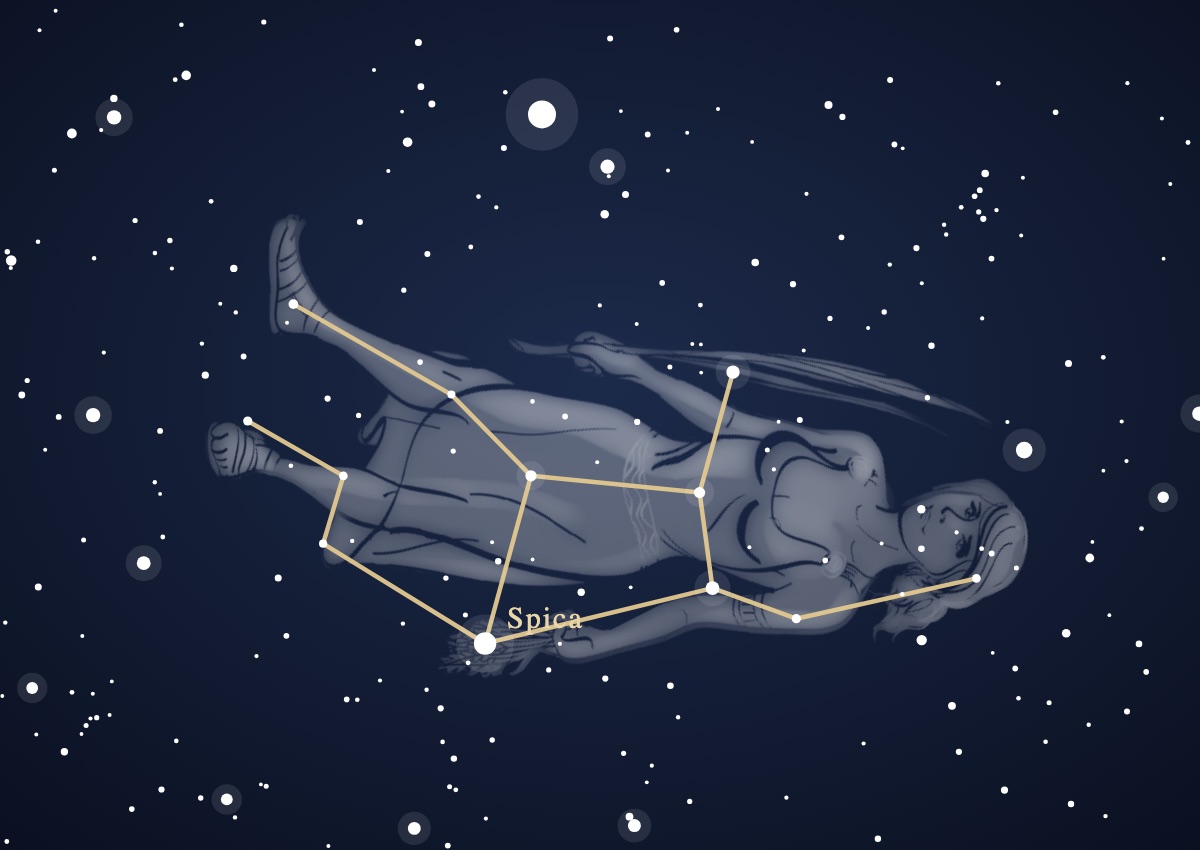
The constellation Virgo
Virgo is a constellation of the northern and southern hemispheres. It lies on the ecliptic and is therefore one of the zodiac constellations. The ecliptic describes the apparent path of the sun over the course of a year. During this time, the sun passes through all the zodiac constellations. From 16 September to 30 October, the sun is in the constellation Virgo. During this time, the constellation cannot be observed because it is in the daytime sky.
It is the largest of the zodiac constellations and the second largest constellation in the sky. It is often associated with Astarte, the goddess of fertility, or Astraea, the goddess of justice. As a sign of fertility, she holds a bunch of ears of grain in her hand. In the northern hemisphere, it represents the beginning of autumn (22 or 23 September), because the sun is in this constellation at this time. In the southern hemisphere, on the other hand, spring begins. On this date, day and night are of equal length (equinox).
The brightest star of Virgo is α Virginis, with the Latin name Spica (ear of grain). It represents the ear of grain in her left hand and is one of the 20 brightest stars in the sky. Virgo contains the Virgo Cluster, with well over a thousand galaxies at a distance of around 54 million light years.
Mythology
The best known of the many myths about the constellation Virgo comes from Greece and is about Persephone, the daughter of Demeter, the goddess of grain and fertility. Zeus had promised Hades, the god of the underworld, that Persephone would become his wife. Hades then carried the girl off to the underworld. In her grief, her mother let all the plants and fields dry up. But Persephone had eaten pomegranate seeds there and therefore had to return. So that humanity would not starve, Zeus made a compromise: from then on, Persephone was to spend one half of the year with her mother and the other in the underworld. It is still true today: whenever Persephone is allowed to go to her mother in spring, everything on earth begins to grow and bloom. When she leaves again for the underworld in autumn, however, everything becomes grey and dull.
Astrological significance
People who were born between 24 August and 23 September are born under the zodiac sign of Virgo. They are extremely disciplined and eager to learn. “Having a good plan” is part of their approach to life. As soon as their analysis is complete, they are ready for action at any time. However, their love of order easily makes them pedantic.